A bent or misaligned tube can disrupt cutting, threading, bending, welding and automated assembly, even when its outside diameter and wall thickness meet specification. By the end, you will understand how controlled roll bending removes lengthwise curvature, which defects require a different process, and how to match a machine and tooling setup to your tube.
Key takeaways
- It corrects residual bow, camber, runout, and local bends in finished tubes.
- Rollers apply controlled alternating bends that move the tube’s centerline toward straightness.
- Measure total bow, local bend, runout, and straightness over the specified tube length.
- Specify tube diameter, wall thickness, material, length, yield strength, and required tolerance.
What physical problem does a tube straightening machine correct?
A tube straightening machine changes a tube’s lengthwise centerline until the finished tube meets a specified straightness limit. If you are asking what is a tube straightening machine, it corrects residual bow, camber, runout and local bends—not merely holding a crooked tube in a straight position.
Bow is a smooth deviation spread along the tube’s length. Camber describes side-to-side curvature, while a local bend is concentrated in a short section. A buyer must also identify twist, end flare and runout during inspection.
1. Measure overall bow over the complete tube and local bends over defined datum lengths. Record camber against a stated chord or straightedge, then check twist along the axis, end flare and end runout. A visual check cannot separate a short bend from end-to-end curvature.
2. Check straightness separately from outside diameter, wall thickness, ovality, weld-bead condition and surface condition. A tube can be straight but oval, or round but bowed. Straightening will not reliably repair a dent, buckle, severe local flattening, weld defect or major wall-thickness eccentricity; forcing such damage can cause cracking or roll marks.
3. Treat the tube straightening machine benefits as functional, not cosmetic. Straight tubes feed more reliably into automatic cutting, threading, bending, swaging, fixtures and dimensional inspection, reducing misalignment and rejected parts. Use the purchase specification’s datum length, maximum deviation and measurement method to confirm the result.
How does the machine remove bow and curvature?
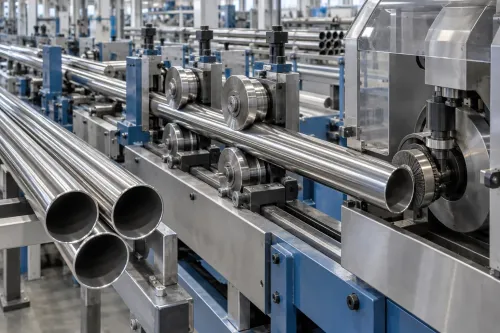
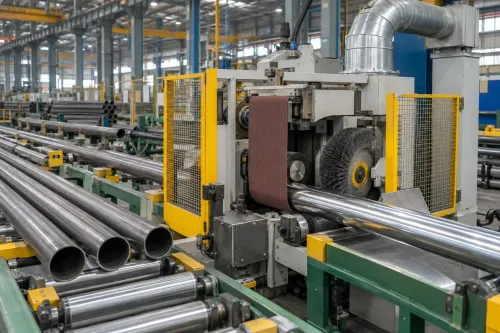
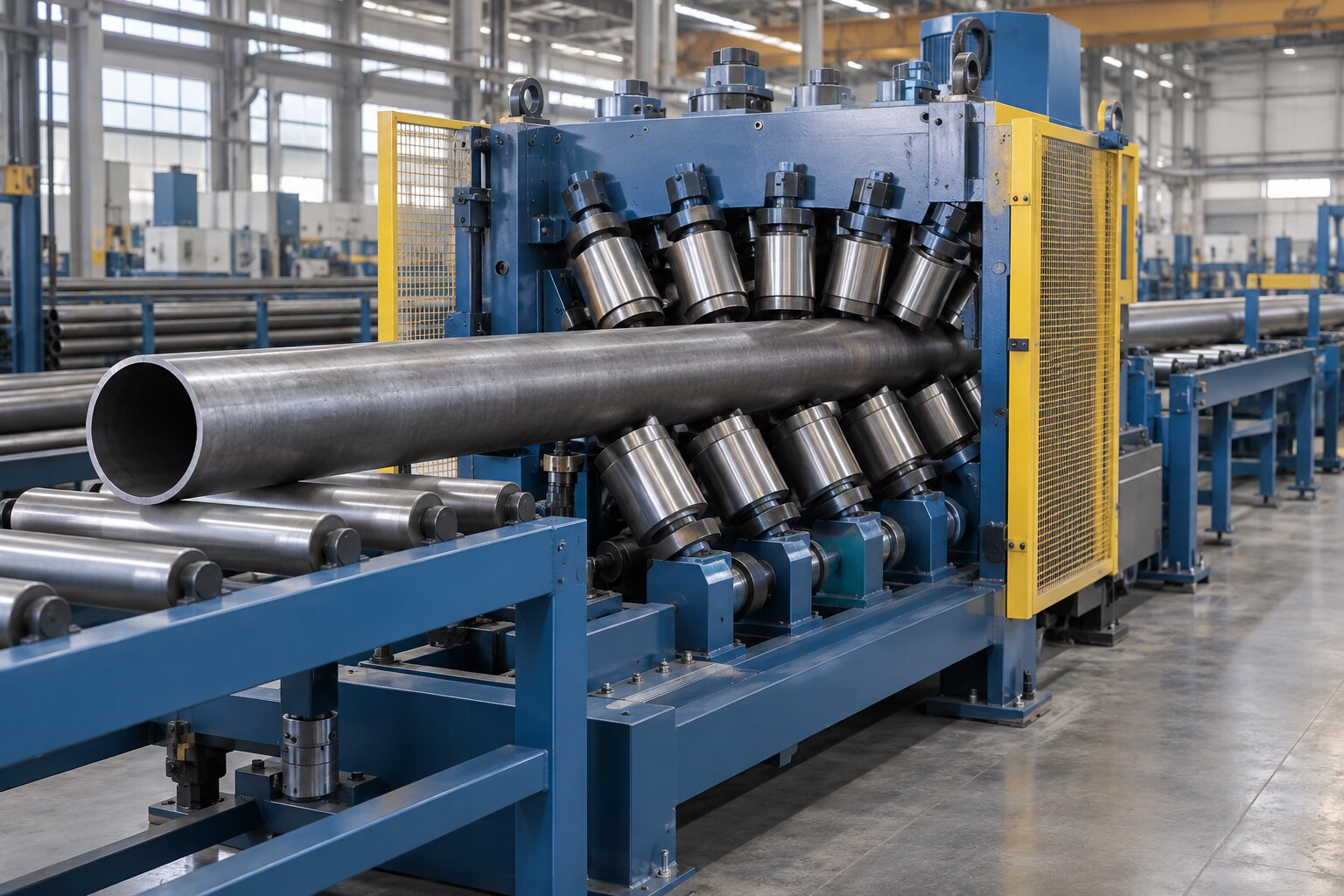
Offset rolls arranged in two or more planes apply alternating bends as the tube passes through them. Each bend points in a different direction, cancelling bow and curvature along the centerline. The machine bends the tube slightly beyond its elastic limit, so controlled plastic deformation remains after the rolls release it.
This is not simple clamping or pressing.
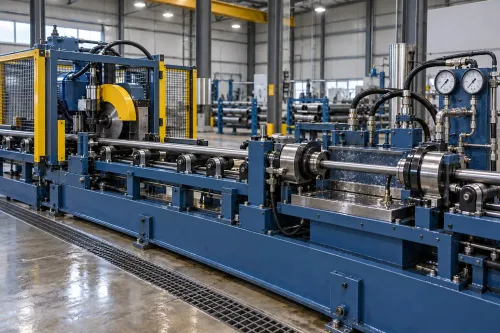
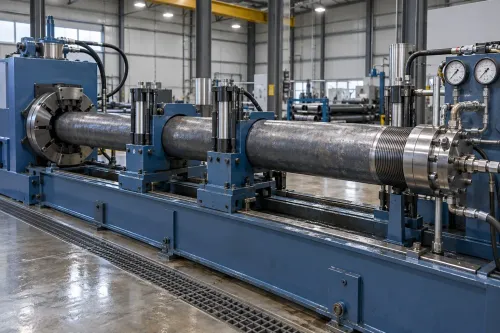
An industrial straightening machine depends on more than nominal roll gap:
| Variable | What it controls | What changes |
|---|---|---|
| Roll penetration | Bending force and correction depth | Greater penetration increases deformation and contact pressure |
| Roll inclination | Tube rotation and helical travel | The tube presents different circumferential areas to the rolls |
| Pass-line height | Contact position and bending direction | Incorrect height shifts the load and destabilizes tracking |
| Roll spacing | Correction length and bend sequence | Wider spacing spreads correction; closer spacing concentrates it |
Change one setting alone and the tube can leave straight while carrying ovality or unstable tracking. The setup balances three outcomes:
| Straightness | Roundness | Residual stress |
|---|---|---|
| Improves with controlled over-bending | Suffers when penetration crushes the section | Rises when bending is excessive or uneven |
Excessive penetration can improve a straightness reading while creating ovality, roll marks, reduced dimensional margin or unfavorable residual stress. Tooling grooves must distribute pressure around the tube: deep grooves can trap and mark it, while shallow grooves cause slipping, edge stress and inconsistent correction.
Which deviations should you measure before and after straightening?
Measure the tube against a defined reference, not by sight. Record each deviation separately:
| Deviation | Measurement | What it reveals |
|---|---|---|
| Overall bow | Maximum gap from a straightedge over the complete tube length | End-to-end curvature |
| Local bend | Maximum gap over a specified shorter datum length | A concentrated bend hidden by an overall check |
| Camber | Offset from a defined chord or straightedge | Side-to-side curvature |
| Twist | Angular change between marked sections along the tube axis | Rotational distortion |
| End flare and runout | Diameter and radial deviation at both tube ends | Distorted ends that affect feeding or assembly |
Your purchase or quality specification must state the datum length, maximum permitted deviation and measurement method. A visual check cannot distinguish a short local bend from smooth curvature across the whole tube.
Check outside diameter, wall thickness, ovality, weld-bead condition and straightness as separate results. A tube can be straight but oval, or round but bowed. Straightening cannot reliably repair a dent, buckle, severe flattening, surface damage, weld defect or wall-thickness eccentricity.
For ERW tube, record weld-seam position and internal or external bead height. The seam changes local stiffness and roll contact; rotating it relative to the rolls can change the response. Include seam orientation in the setup specification when the application requires it.
These measurements show the real tube straightening machine benefits without confusing straightness with overall tube quality, and they give tube straightening equipment a measurable acceptance target.
What happens during a normal straightening-machine setup?
Start with a sample, not maximum pressure. A normal setup establishes the pass line, confirms the tube condition and uses low roll penetration before increasing correction.
1. Load a cut tube into an offline industrial straightening machine, or establish the inline pass line after welding, sizing or annealing. Run the first sample at a controlled speed and inspect its initial curvature.
2. Set roll positions, pass-line height, roll inclination and roll spacing for the tube’s diameter, wall thickness and grade. Begin with low penetration; forcing pressure until the tube merely looks straight can create ovality, roll marks and residual stress.
3. Measure the sample against the specified straightedge, chord or gauge over the stated datum length. Check ovality, surface marks, end condition, weld-seam behavior and whether the tube tracks without wobbling or slipping.
4. Change penetration and inclination in small steps, rerun a sample and record each result. Accept the setting only when straightness and dimensional limits both pass.
Tube length and starting shape change the response: a short cut tube reacts differently from a long continuous tube, while a local bend needs a different setup from distributed bow. Inline tube straightening equipment handles continuous production; offline equipment processes bundles of cut tubes.
Record tube size, grade, condition, roll setting, line speed and inspection results in the commissioning record.
Which straightener design and tube inputs determine the right machine?
The right tube straightening machine depends on the correction pattern and the tube inputs, not diameter alone.
| Design | How it works | Best fit | Main control |
|---|---|---|---|
| Two-roll rotary | Skewed rolls advance and rotate the tube, exposing its circumference to pressure | Consistent roundness and straightness | Roll angle, tube support and spiral feed pattern |
| Multi-roll | Several rolls in multiple planes distribute correction | Tubes after ERW welding, sizing, annealing or cut-to-length | Roll positions, support and pass-line stability |
| Press straightening | Force is applied at selected points | Localized correction or heavier sections | Force location, load and deflection |
A two-roll rotary design suits continuous finishing but can create unstable helical tracking if the roll angle or support is wrong. A press machine is less suitable for continuous, high-throughput production.
Provide these inputs before selecting an industrial straightening machine:
- Outside diameter and wall thickness
- Tube length
- Steel grade and yield strength
- Hardening behavior
- Initial deviation
- Surface condition
- Target production rate
- Required straightness
Tube condition changes the answer. Welded, drawn, annealed, hot-finished and cold-finished tubes have different stiffness and springback, even at the same diameter. Weld type, bead height and condition, plus seam orientation, affect roll contact, tooling and settings. A prominent ERW bead can change local stiffness, so control seam position when the application demands it.
What should you specify when choosing tube straightening equipment?
Specify the complete production envelope and proof of performance, not merely the machine name or nominal capacity. That protects the tube straightening machine benefits: straightness without lost roundness, marks or throughput.
- Tube range: minimum and maximum outside diameter, wall thickness, length, grade, strength and hardening behavior.
- Production: continuous or batch-based, target speed and size-change time.
- Acceptance: straightness datum, measurement method, maximum deviation, allowable ovality, surface marking and residual-deformation limits.
- Ask how rolls support the section, control seam orientation, change settings between sizes and inspect samples during commissioning.
- Request data for roll penetration, inclination, pass-line height, spacing, tooling groove geometry and line speed.
Gallium Equipment Pvt. Ltd. is worth involving when tube-forming, handling and straightening must match your material range and inspection method.
| Requirement | Continuous line | Batch line |
|---|---|---|
| Production | Inline flow | Offline bundles |
| Priority | Throughput and stability | Flexibility across sizes |
| Proof | Sustained speed and rejection rate | Repeatable settings per batch |
Frequently asked questions
What physical problem does a tube straightening machine correct?
It corrects lengthwise deviations such as residual bow, camber, runout, and local bends after forming, welding, cutting, or heat treatment.
How does a tube straightening machine remove bow and curvature?
Adjustable rollers apply controlled, alternating bends that exceed the tube’s elastic limit in selected areas, shifting its centerline toward the required straightness.
Which deviations should you measure before and after straightening?
Measure total bow over the specified length, local bend, end runout, cross-sectional rotation, and the final straightness value against the drawing or applicable product standard.
What happens during a normal straightening-machine setup?
The operator confirms tube dimensions and material, aligns the entry and exit guides, sets roller positions, runs a trial piece, measures it, and adjusts pressure or roller offsets.
Which straightener design and tube inputs determine the right machine?
Choose the design from the tube’s diameter, wall thickness, length, material strength, section shape, initial curvature, production rate, and required straightness tolerance.
Keywords