Wire rod is an intermediate steel product whose final performance depends on billet quality, rolling temperature, finishing speed and controlled cooling—not on diameter alone. By the end, you will be able to trace the complete mill route, match equipment and process controls to a product mix, identify the evidence behind common defects and compare suppliers against a practical production specification.
Key takeaways
- Match wire rod grade and diameter to drawing, heading, or forming requirements.
- Control pass design, rolling speed, and cooling to achieve the target metallurgy.
- Inspect coils for surface cracks, dimensional variation, scale, and chemistry errors.
- Compare mills by throughput, coil weight, automation, energy use, and product range.
What Wire Rod Is, and Which Grades and Sizes It Serves
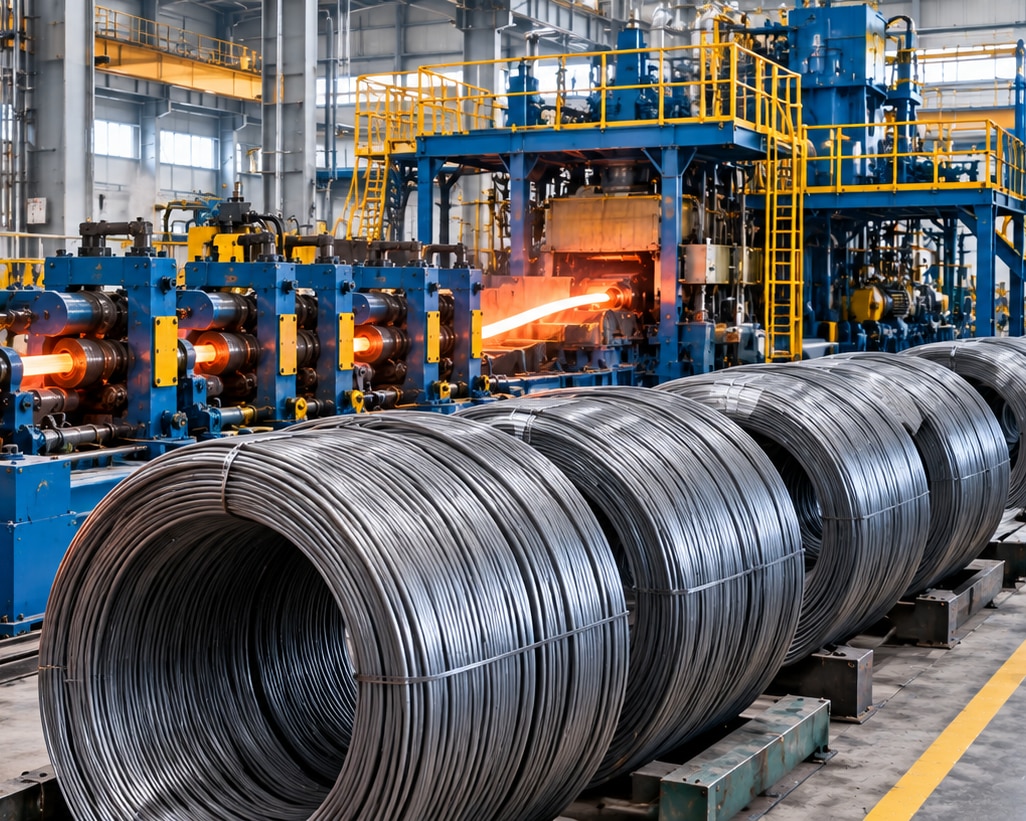
Wire rod is a hot-rolled, round steel product collected in coils for further processing, not a finished steel wire. A practical wire rod definition includes a controlled diameter, surface condition and chemistry suitable for drawing, heading or forming.
Commercial 5.5–25 mm wire rod sizes cover much of the market; 5.5 mm demands far higher finishing and laying speeds than 25 mm.
| Product | What distinguishes it | Typical intended use |
|---|---|---|
| Wire rod | Round, hot-rolled and coiled; supplied for downstream deformation | Drawing, cold heading, springs, welding wire, rope and tyre cord |
| Bar | Usually supplied in straight lengths, with larger sections or different dimensional tolerances | Reinforcing, machining, structural and general engineering parts |
| Strip | Flat, wide and thin rather than round | Stamping, packaging, electrical parts and formed sections |
| Finished wire | Drawn or otherwise processed to final diameter and properties | Nails, mesh, fasteners, cables, bead wire and wire rope |
Grade determines more than strength. Low-carbon cold-heading rod needs low inclusions, controlled decarburization and uniform hardness, because surface flaws can split during heading. High-carbon rod for tyre cord, bead wire and rope needs a fine, consistent pearlitic structure for severe drawing. Spring, welding-electrode and free-cutting grades require different chemistry and cleanliness.
Specify the standard with the grade and diameter: EN 10263 covers steels for cold heading and cold extrusion, EN 10089 covers spring steels, and ASTM A510/A510M covers carbon and alloy steel wire rod. The standard fixes chemistry, tolerances, testing and surface limits; the end use determines which grade is suitable.
How Billet Becomes a Continuous Wire-Rod Coil
1. Billet charging places a cut, inspected billet onto the walking-beam entry table, where its heat number and dimensions are recorded. The billet then enters the reheating furnace.
2. The reheating furnace raises the steel uniformly to its rolling temperature. Uneven heating leaves hard zones, scale and temperature differences that later appear as surface or dimensional defects.
3. High-pressure jets perform water-pressure descaling before the first pass. The roughing stands reduce the billet section and break down its cast structure; excess or poorly aimed water causes temperature variation.
4. Intermediate stands continue reducing the section through close pass sequences. Loopers store a small length between stands, absorbing speed differences and preventing tension from stretching the rod or causing cobbles.
5. Closely spaced finishing block stands make the final diameter at high speed. Guides, loopers, pyrometers and dimensional gauges track the rod; a small alignment or temperature error can repeat throughout an entire coil.
6. Pinch rolls feed the finished rod into the laying head, which bends it into overlapping rings. The ring diameter and nesting pattern determine whether the coil pays off smoothly.
7. The rings land on a controlled-cooling conveyor, where airflow and conveyor speed establish the required cooling rate and metallurgical structure. Cooling too quickly or unevenly produces property variation around the coil.
8. A reforming or compacting device aligns and compresses the cooled rings before coil collection. The finished coil is weighed, identified against its billet heat and rolling data, and transferred for storage or dispatch.
How Rolling Speed, Pass Design and Cooling Set the Metallurgy
At 90–120 m/s, a high-speed wire rod mill has little tolerance for unstable metal flow. A poor guide, worn roll or mis-set stand changes delivery speed and creates tension between stands, producing diameter variation, ovality and cobbles.
A wire rod pass schedule determines how reduction is shared across roughing, intermediate and finishing stands. Roll-pass design controls the groove shape, contact area and rotation of the section; excessive reduction overheats the surface and accelerates roll wear, while insufficient reduction leaves poor shape control.
Loopers and tension control keep each stand biting a stable section instead of pulling or buckling it.
The main cause-and-effect links are:
- Interstand tension: Too much tension reduces measured diameter and increases longitudinal variation; compression causes loops, folding and cobbles.
- Finishing temperature: A high exit temperature lowers flow stress but can coarsen austenite; a low temperature raises rolling load and can produce uneven transformation.
- Guide and block alignment: Misalignment marks the surface and shifts the section off-centre, increasing ovality.
- Laying-head performance: Unbalanced speed, vibration or a worn pinch roll distorts rings, causing loose edges, tangled coils and poor package density.
- Controlled cooling: Airflow, hood position, conveyor speed and ring density set the cooling curve, which determines ferrite-pearlite morphology, strength, ductility and drawability.
High-carbon rod for tyre cord, bead wire and rope needs fine, uniform pearlite across the coil. Cooling variation gives downstream drawing equipment inconsistent resistance and breakage, while correct ring formation ensures stable coil handling and pay-off.
Defects, Inspection and Downstream Industrial Applications
Seams and laps, slivers, scratches and rolled-in scale expose billet or descaling problems; drawing can open them into splits. Oscillation marks and uneven diameter point to laying, tension or roll-control faults. Decarburisation and non-metallic inclusions become crack starters during heading, spring forming or severe drawing.
Inspection combines dimensional checks, surface examination and laboratory tests. Use eddy-current or magnetic-flux inspection for discontinuities, chemical analysis for grade confirmation, and metallography for pearlite, grain structure and inclusions. Tensile testing wire rod confirms strength, elongation and consistency; measure hardness across the coil and perform decarburisation measurement on a polished cross-section.
Sample both coil ends and the middle, because cooling variation can produce different properties along one coil.
- High-carbon rod needs fine, uniform pearlite and narrow strength variation before dry or wet drawing, patenting, tyre-cord, bead-wire and rope production.
- Cold-heading rod needs clean surfaces, low decarburisation and uniform hardness; an acceptable average tensile result does not prevent cracking under the heading die.
- Spring rod is drawn or oil-tempered before forming, so inclusions, laps and local hardness peaks must be controlled.
- Welding wire rod is cleaned, drawn and surface-treated before copper coating; mesh, nails, fasteners and electrodes use comparable drawing and straightening routes.
| Application | Preparation | Main quality concern |
|---|---|---|
| Tyre cord, bead wire, rope | Patent, draw and sometimes coat | Uniform pearlite and drawability |
| Cold heading | Pickle, draw, spheroidise or anneal | Surface and decarburisation |
| Springs | Draw, oil-temper and form | Cleanliness and fatigue strength |
| Welding wire | Draw, clean and copper-coat | Surface finish and chemistry |
How to Specify and Compare a Wire Rod Mill
Compare on saleable tonnes per year, not the headline rolling speed. Your mill capacity calculation tonnes per hour is annual saleable tonnage divided by scheduled operating hours, adjusted for yield, planned maintenance, grade changes and cobble losses.
| Option | Best fit by tonnage and product mix | Utilities and operating effort | Automation and commissioning risk |
|---|---|---|---|
| High-speed wire-rod mill | High annual tonnage and narrow, repeatable rod families | High electrical, cooling-air and water demand; skilled operation | Highest: 90–120 m/s exposes guide, pinch-roll, laying-head and vibration errors |
| Conventional bar mill | Mixed bar sizes, lower speed and frequent size changes | Simpler controls and lower cooling complexity | Moderate; unsuitable if consistent ring-shaped coils are essential |
| Mini-mill | Moderate tonnage near a regional market or steel source | Lower footprint, but capacity and redundancy are limited | Lower equipment scale, yet integration delays can erase the schedule advantage |
| Bar-in-coil line | Coiled bar where downstream handling values compact packages over maximum rod speed | Requires reliable cooling, reforming, coil compactor and tying equipment | Moderate; confirm coil weight, ring nesting and pay-off compatibility |
Specify the Stelmor-type cooling conveyor by air-flow zones, hood position, conveyor speed and target cooling curve, not merely its length. Include changeover time, inspection access, spare guides and operator training in the bid. Gallium Equipment Pvt.
Ltd. can help separate auxiliary handling scope from core mill scope when a project combines wire processing with tube or strip equipment.
Frequently asked questions
What is wire rod, and how does it differ from finished wire?
Wire rod is a hot-rolled, round steel product collected in coils. It is processed further by drawing, heading, or forming, while finished wire has undergone additional size reduction or treatment.
How does a billet become a continuous wire-rod coil?
The mill reheats a steel billet, removes scale, reduces its section through successive rolling stands, applies controlled cooling, and forms the finished rod into a coil.
How do rolling speed, pass design, and cooling affect wire rod?
Pass design controls section reduction and dimensional accuracy, rolling speed affects temperature and throughput, and controlled cooling sets the rod's microstructure and mechanical properties.
Which defects should you inspect in wire rod?
Inspect for surface cracks, laps, seams, scale, poor coil formation, diameter variation, ovality, and chemistry or mechanical-property deviations.
How should you compare wire rod mills?
Compare billet size, product diameter range, tonnes-per-hour capacity, maximum finishing speed, coil weight, cooling technology, automation, energy consumption, and inspection systems.