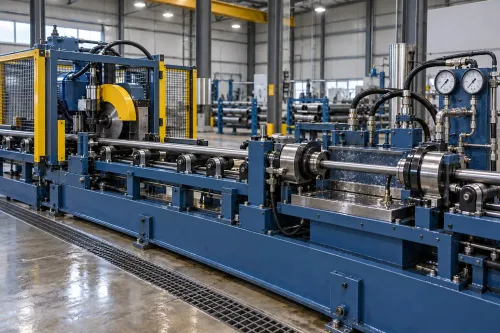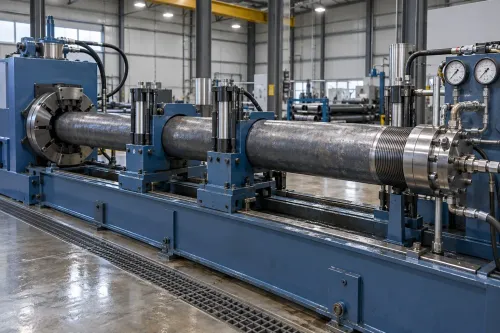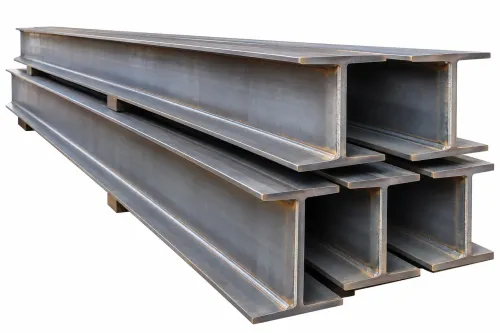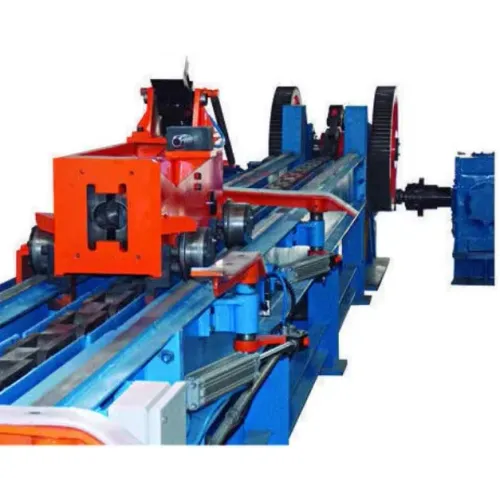
Finishing starts after forming and sizing, but the correct equipment depends on the tube’s section, wall thickness, steel grade, required length and customer standard. By the end, you will be able to map each operation, compare inline and standalone layouts, specify inspection and threading requirements, and screen machinery against the conditions in your Faridabad plant.
Key takeaways
- Define length, tolerance, end condition and test requirements before requesting quotations.
- Match straightener roll count and cutting speed to tube diameter and production rate.
- Specify thread form, gauge standard, thread length and inspection method.
- Choose inline equipment for flow; choose standalone machines for varied batches.
What counts as tube finishing after forming and welding?
Tube finishing starts after the tube has been formed and welded, or after a drawn tube leaves the draw bench. It covers operations that bring the tube to saleable length, geometry, surface condition, test status and dispatch form.
A tube mill does not automatically include these downstream functions, so tube finishing equipment for manufacturers must be specified separately.
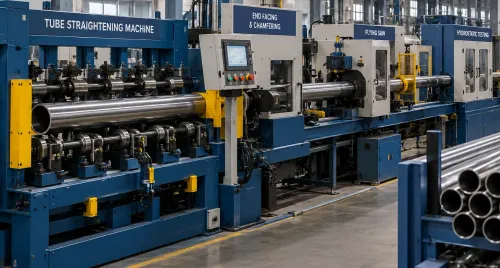
1. For ERW tube, begin after the forming, welding and sizing stands: flying cut-off, end deburring or chamfering, straightening, inspection, marking, bundling and packing. The flying saw must synchronise with the moving tube; otherwise cuts become angled and lengths vary.
2. For stainless-steel or heat-treated tube, put annealing before sizing and finishing when the process requires heat treatment. After the annealing line, perform cut-to-length, straightening, inspection and end preparation.
3. For drawn tube, the draw bench comes first. Follow it with straightening, cut-to-length, end-facing, testing and dispatch preparation.
Decoilers, coil joining equipment and HF tube mills are upstream machinery, not finishing equipment. Hydrostatic testing proves pressure containment at a defined pressure and duration; eddy-current testing detects specified discontinuities through electromagnetic response; ultrasonic testing uses sound waves to find defined flaws. These are inspection stages, not interchangeable processes.
Which finishing machine solves each production problem?
Match each defect or handling problem to the machine that removes it; tube finishing equipment is not interchangeable.
| Machine | Problem solved | Selection point |
|---|---|---|
| Flying cut-off saw | Cuts moving tube without stopping the line | Synchronisation prevents angled cuts, length variation and surface damage |
| Cold saw | Produces clean, controllable cuts | Select the blade, chip evacuation and maintenance plan |
| Abrasive cut-off machine | Cuts difficult grades on simpler lines | Allow for sparks, dust, heat-affected residue and extra end cleaning |
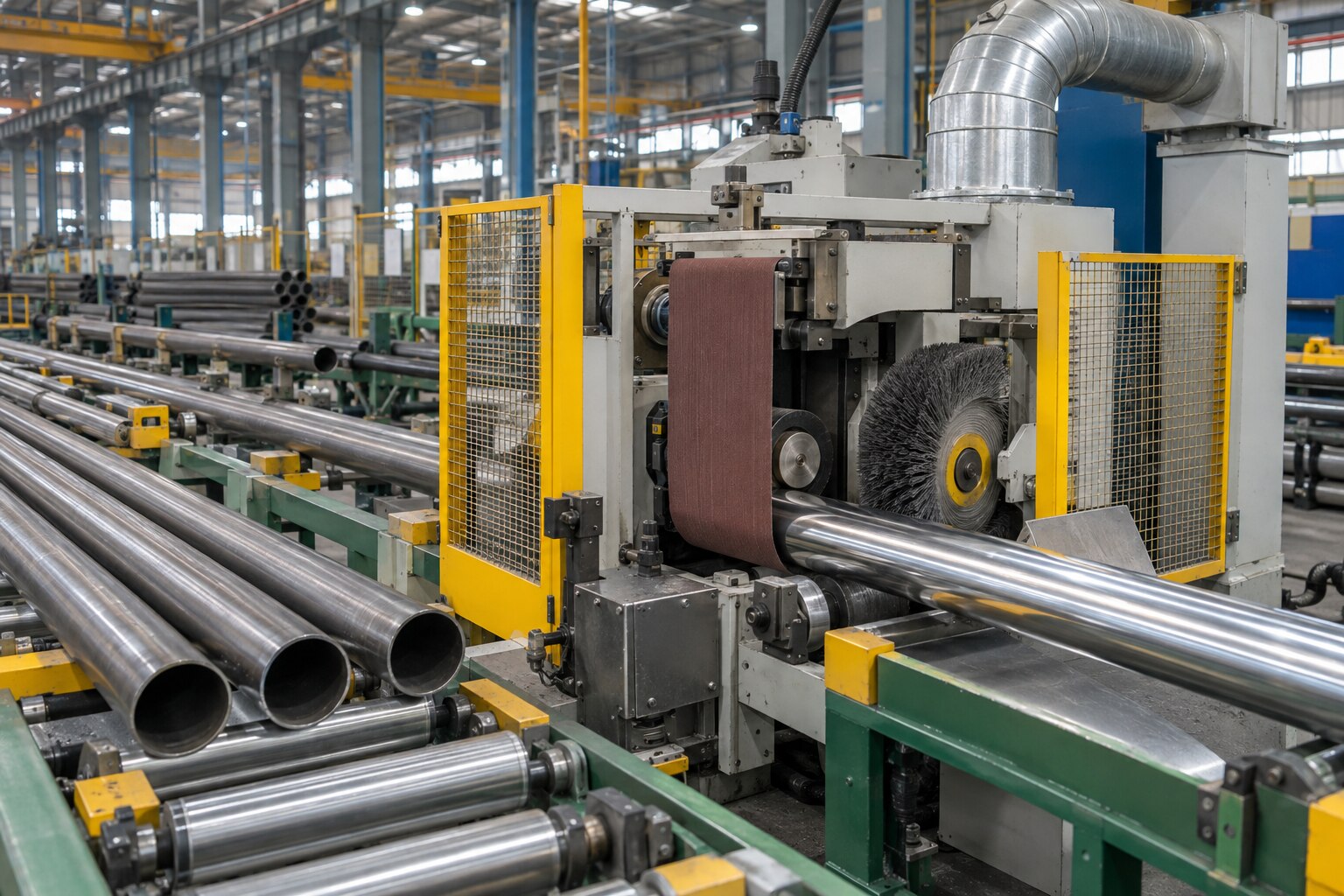
| Deburring unit | Removes sharp internal or external edges | Do not treat it as a thread-entry chamfer |
| End-facing unit | Controls end squareness and finished length | Specify the permitted face error |
| Chamfering unit | Prepares ends for threading, socketing or assembly | Define angle, width and repeatability |
A flying cut-off specification must state maximum line speed, outside-diameter range, wall-thickness range, cut-length tolerance and allowable end squareness. Include acceleration, tube tracking and blade-change access in the tube finishing machinery review.
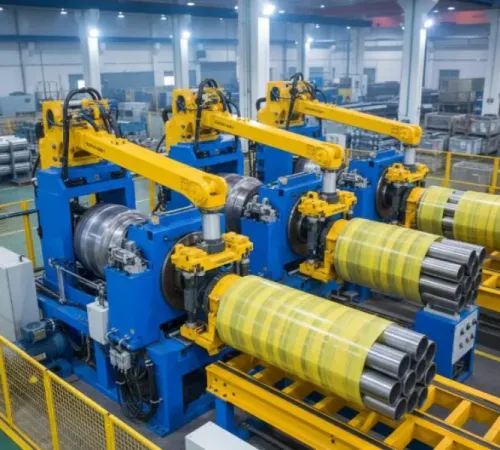
Treat bundling as a quality operation, not optional packaging. Require controlled counting, tube alignment, strapping tension, bundle weight and traceability; poor control causes mixed lengths, ovality and handling damage.
Add marking for heat number, grade, size, batch or order identification. Provide guarded scrap chutes, collection bins and safe removal routes so offcuts and abrasive residue cannot obstruct operators or contaminate finished tubes.
How should you choose straightening, cutting and end-finishing capacity?
Choose capacity from the complete product envelope, not the largest nominal diameter. For a tube finishing equipment tube for producers in Faridabad, require the supplier to state:
- Tube outside-diameter and wall-thickness ranges
- Round, square or rectangular section
- Tube length, steel grade and yield strength
- Maximum line speed and cut-length tolerance
- Bundle weight and permissible residual straightness tolerance
| Method | Best use | Main limitation |
|---|---|---|
| Roller straightening | Continuous reduction of bow and curvature | Excessive force can flatten thin-wall tube or alter diameter |
| Rotary straightening | Controlled correction around the tube circumference | Requires accurate support and setup |
| Press straightening | Local or heavier correction on fixed lengths | Slower and can leave residual stress |
For tube finishing equipment for manufacturers, ask for the number and diameter of rolls, support arrangement, clamping method and changeover tooling. Confirm that the flying cut-off synchronises with the moving tube; poor tracking produces angled ends, variable lengths or surface damage.
Capacity also includes end treatment. Define whether deburring, brushing, chamfering and end-facing apply to every size, and specify the permissible end squareness. For galvanized or coated tube, state whether zinc loss at the cut end requires zinc-rich repair, a post-treatment or acceptance of the exposed end.
Without that decision, handling and finishing can turn an acceptable tube into a rejected batch.
What threading and testing details belong in the purchase specification?
A threading unit is not enough: the order must define the accepted threaded product. Name BSP, NPT, ISO metric or API requirements, thread length, chamfer geometry, pitch, permissible runout, and whether threading covers fixed lengths or continuously produced tube ends.
Specify chip control, coolant type and delivery, workholding, thread inspection, and GO and NO-GO gauges. State gauge size, inspection frequency and the acceptance record; otherwise a machine can cut threads that assemble poorly or fail the named product standard.
| Test method | What it proves or detects | Purchase details to specify |
|---|---|---|
| Hydrostatic | Pressure containment at a defined test pressure and duration | Pressure, hold time, sealing, leak detection and reject handling |
| Eddy-current | Specified surface or near-surface discontinuities | Reference standards with known artificial defects, sensitivity, calibration frequency and reject handling |
| Ultrasonic | Specified discontinuities in the weld zone or tube body | Calibration blocks, sensitivity, coverage and reject handling |
For ultrasonic testing, state whether the system inspects only the longitudinal weld or the complete tube surface. Define how calibration blocks represent the actual tube size and grade.
For eddy-current testing, address lift-off, probe position, permeability, tube geometry and weld-bead condition. Installing a coil alone does not establish compliance.
Tie the tube finishing equipment and tube finishing machinery to the order standard, not “BIS compatible.” Name IS 1239, IS 4923 or IS 1161 as applicable, then specify its dimensional, testing, marking and inspection requirements.
Should you buy an inline finishing system or standalone machines?
Choose inline finishing when continuous flow matters more than isolated maintenance; choose standalone machines when product mix and access matter more than uninterrupted mill output.
| Option | Strength | Cost or risk |
|---|---|---|
| Inline flying cut-off and inspection | Continuous production, low handling and small floor footprint | A fault can stop the upstream mill; access and changeover space are restricted |
| Standalone cutting, straightening, threading or testing | Flexible maintenance, easier changeovers and better crane access | Requires accumulation, storage, extra handling and tighter traceability control |
A site survey must record electrical supply, compressed-air pressure and consumption, cooling-water flow, chip or abrasive-dust extraction, ambient dust and heat, floor loading, safe scrap removal and bundle movement. For tube finishing equipment for manufacturers, these services often limit usable throughput before headline speed does.
Nominal diameter range is not enough for one line handling thin-wall precision tube, heavy-wall structural tube, threaded pipe and galvanized conduit. Specify tooling, support rolls, clamps, chamfer geometry and inspection heads for each product family.
Ask for trials using your grades, sizes, wall thicknesses, surface condition and target lengths. Gallium Equipment Pvt. Ltd. can support that comparison with customized finishing machinery packages; judge usable throughput, changeover time and accepted output rather than catalogue speed.
For tube finishing equipment tube for producers in Faridabad, require these procurement records:
- Accumulation capacity and maximum changeover time
- Operator and crane access at every machine
- Stopping logic when a downstream unit is unavailable
- Scrap, bundle and inspection traceability method
Related products
 | Tube Bundling Machine The Tube Bundling Machine from Gallium Equipment Pvt. Ltd. is designed to automate the bundling and packaging of steel tubes with precision and... View product → |
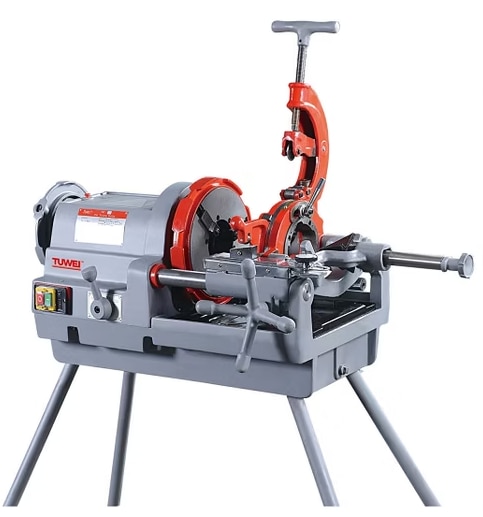 | Tube Threading Machine The Tube Threading Machine from Gallium Equipment Pvt. Ltd. is engineered for accurate and efficient threading of steel tubes used in industrial and... View product → |
Frequently asked questions
What counts as tube finishing after forming and welding?
Finishing includes sizing or straightening, cutting to saleable length, deburring, end forming, threading, testing, marking, bundling and dispatch preparation.
Which finishing machine solves each production problem?
Use straighteners for bend and ovality, flying or cold saws for length, end-facing and deburring machines for clean ends, and hydrostatic, eddy-current or ultrasonic systems for specified tests.
How should you choose straightening, cutting and end-finishing capacity?
Start with tube diameter, wall thickness, material grade, finished length, dimensional tolerances, pieces per minute and the required bundle output.
What threading and testing details belong in the purchase specification?
State the thread form, nominal size, pitch, thread length, gauge system, permissible defects, test pressure or method, test duration and inspection records.
Should you buy an inline finishing system or standalone machines?
Choose inline equipment for stable products and continuous flow; choose standalone machines when product sizes, lengths or finishing operations change between batches.
Related product
 | Pipe straightening Machine plays a vital role in improving the quality of ERW,SS Tubes being produce on Tube Mills & Draw Benches and after annealing... View product → |
Keywords