Choosing a large-diameter pipe involves more than comparing outside diameter and wall thickness. You will be able to match the helical manufacturing route to the service, specify the production and inspection requirements, and identify when longitudinal SAW or seamless pipe is the safer choice.
Key takeaways
- Specify pipe diameter, wall thickness, grade, seam requirements and acceptance tests.
- Use HSAW for efficient large-diameter production when spiral-seam controls fit the service.
- Compare HSAW with LSAW and ERW against pressure, diameter, volume and inspection needs.
- Audit forming, welding, ultrasonic testing, hydrotesting and traceability before production.
How a helical submerged arc welded pipe is made
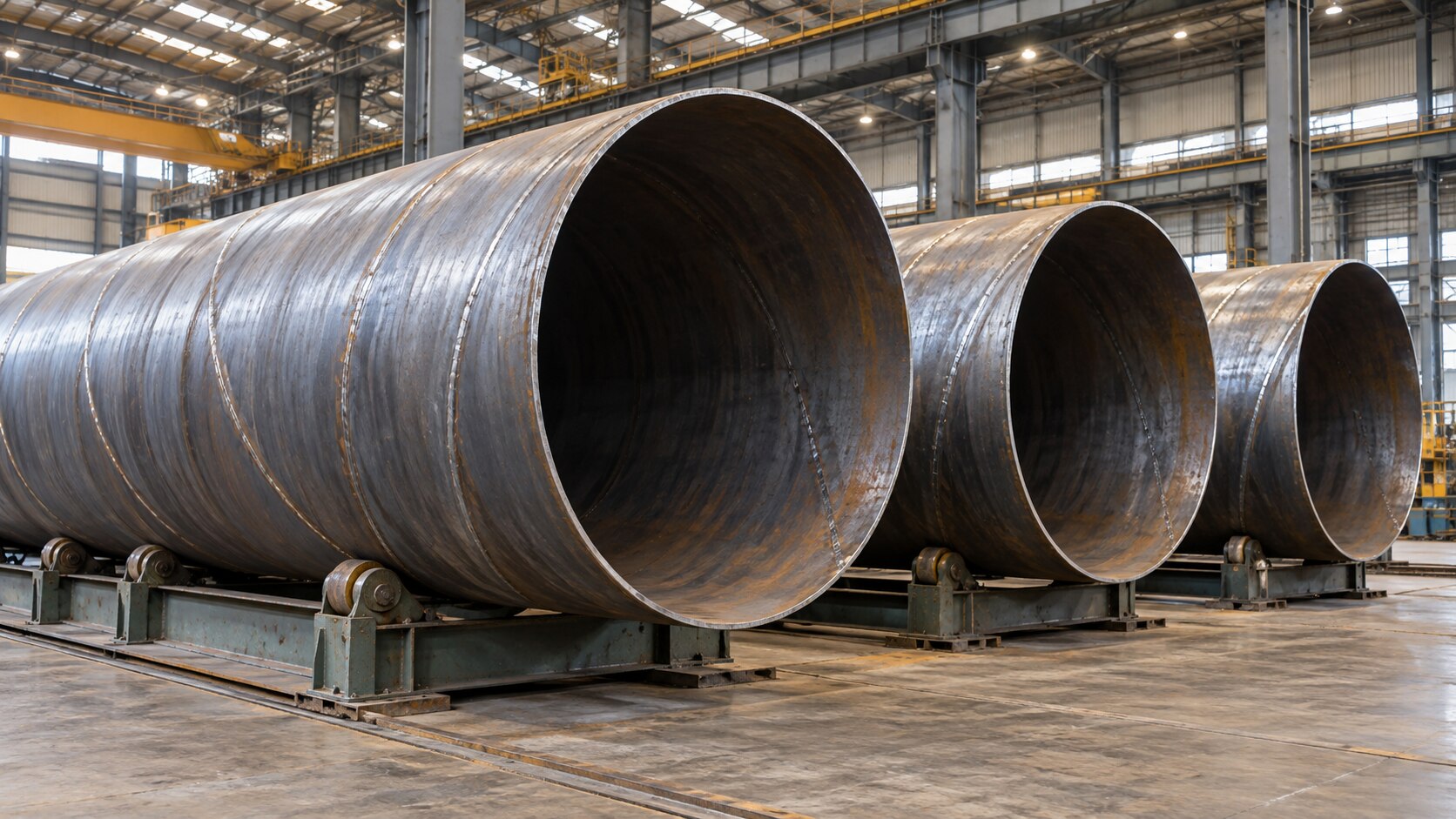
Helical Submerged Arc Welded Pipes are made by continuously converting steel strip into a cylindrical helix and joining its abutting edges with submerged arc welding. Unlike longitudinal SAW pipe, which uses a plate or wide strip and welds along its length, HSAW pipe carries a helical seam around the pipe.
The production sequence is:
- A steel coil enters the mill, where it is uncoiled, straightened and leveled. The line records the coil identity and verifies strip width, thickness, grade and surface condition.
- The strip edges are milled or otherwise prepared to produce the specified groove. The forming angle and strip width together determine the pipe circumference and outside diameter; strip width alone does not set the diameter.
- Roll stands carry out spiral forming, bending the strip into a continuous tube. Guides maintain alignment and control the gap between the abutting edges.
- Submerged arc welding joins the seam under a layer of granular flux. Many mills weld from the inside and outside, controlling penetration, bead overlap, interpass temperature, and the position of starts and stops.
- The mill cuts the continuous tube into individual lengths. A coil-to-coil splice must be removed or processed under a qualified procedure with defined inspection and acceptance criteria.
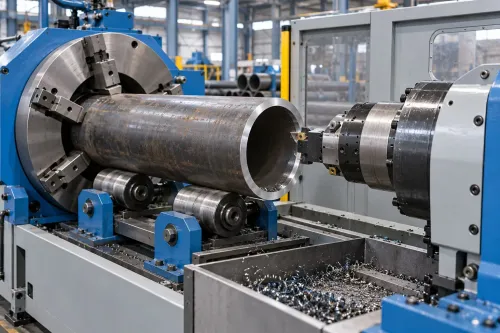
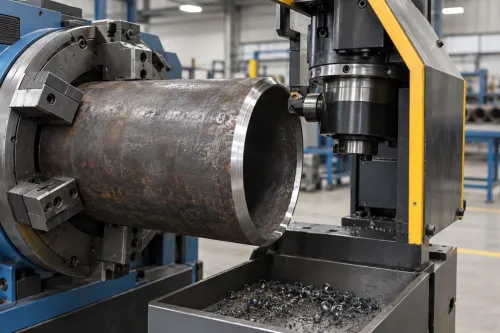
- Each pipe is end-trimmed, faced and beveled. The operation must preserve end squareness, weld cutback and the specified weld-free length.
- Inspection checks weld integrity, dimensions and surface condition before coating, marking and dispatch. Because the helical seam is longer than a longitudinal seam, welding speed and inspection coverage must match its actual length.
How helix angle changes diameter, weld length and quality control
For a fixed strip width, pipe diameter is set by helix geometry as well as the material. If α is the angle between the seam and pipe axis, a useful relationship is D ≈ W/(π sin α): W is strip width and D is pipe diameter.
Reducing α increases pipe diameter; increasing α reduces it. Confirm the mill’s angle convention before comparing settings, because some controls define the angle from the circumferential direction.
The same geometry lengthens the seam. For an axial pipe length L, weld length is approximately L/cos α, so an oblique seam consumes more welding time and wire than a longitudinal seam. Welding speed, heat input, deposition rate and welding-head capacity must therefore match seam length, not just daily pipe output.
Changing the angle also changes forming strain, springback and the axial-circumferential balance of residual stress. Poor strip tracking can produce diameter variation, edge mismatch or local flattening. For Large-Diameter Pipeline Applications, control these points at each diameter change:
- Verify strip width, helix angle and calculated circumference before production.
- Measure outside diameter, ovality, wall thickness and end squareness along the pipe.
- Inspect the full helical seam and record coil-join location, weld cutback and weld-free end length.
- Check bevel geometry carefully; an angled seam near the end can disrupt field fit-up and girth-weld NDT.
HSAW, LSAW or ERW: which route fits the pipeline service?
Choose HSAW when large diameter, high output and diameter flexibility matter more than the shortest possible weld seam. Helical Submerged Arc Welded Pipes suit water transmission, irrigation, dredging and slurry lines when the specified grade, wall thickness, abrasion allowance and inspection plan are adequate.
They also serve piling and structural columns, where axial and bending loads govern rather than internal pressure.
| Route | Best fit | Main caution |
|---|---|---|
| HSAW | Large-diameter water, irrigation, slurry, piling, structural and permitted oil and gas lines; buried or elevated service | Confirm code approval, fracture toughness, sour-service limits, seam NDT and coil-join controls |
| LSAW pipe | High-pressure transmission, demanding oil and gas service, heavy wall and projects requiring a longitudinal seam | Less diameter flexibility and greater dependence on wide plate or heavy strip |
| ERW pipe | Smaller or moderate diameters, lighter wall distribution and structural applications | Do not treat it as a substitute for a qualified large-diameter SAW route |
Buried or elevated installation does not select the process by itself. Specify external loads, span supports, settlement, buckling, corrosion protection and pressure; then check whether the seam and dimensional tolerances meet the governing standard. A buried water main can favour HSAW, while an elevated high-pressure gas line may demand LSAW pipe.
Choose seamless pipe when the specification requires no welded seam, very high pressure or severe cyclic and sour-service performance within available sizes. It costs more and becomes less practical at very large diameters, so do not select it merely because “seamless” sounds safer.
The standard, test and acceptance documents to put in the order
Specify the governing product standard before you specify tests: API Specification 5L or ISO 3183 for line pipe, ASTM A252 for piling, and ASTM A672 only when the project expressly accepts its electric-fusion-welded construction requirements for the proposed pipe.
| Standard | Steel grade and order details | Inspection and acceptance records |
|---|---|---|
| API Specification 5L / ISO 3183 | Grade, PSL1 or PSL2, delivery condition, diameter, wall thickness, pipe-end type, length tolerance and supplementary requirements | Hydrostatic test basis, weld-seam UT and/or RT coverage, calibration records, dimensional report, material certificate and full traceability |
| ASTM A252 | Grade 1, 2 or 3, outside diameter, wall thickness, length and pile-end requirements | Chemistry and tensile records, dimensional checks, weld inspection required by the project, and a certificate stating compliance with A252 |
| ASTM A672 | Grade and class, heat treatment, dimensions and service design | EFW-specific weld, heat-treatment, hydrostatic and NDT records; confirm in writing that this standard permits the proposed HSAW route |
For API 5L or ISO 3183, select PSL2 when the design needs tighter chemistry, toughness, testing and traceability controls. Name the test method, coverage, reference standard, calibration frequency, operator qualification and acceptance level; “hydrotested” alone is not an acceptance requirement.
Require records for weld starts, stops and coil splices. The splice must be removed from the finished pipe or processed under a qualified procedure with defined inspection and acceptance limits. Also require signed reports for hydrostatic pressure and hold time, weld NDT, dimensions, ends, coating and nonconformity disposition.
How to evaluate an HSAW line before committing to production
Do not approve an HSAW line because its brochure lists a diameter range. For Large-Diameter Pipeline Applications, demand evidence that the complete line can hold the specified diameter, wall thickness, grade, seam quality and production rate on your actual strip.
1. Request a proven production chart showing strip width, thickness, helix angle, outside diameter, pipe length and speed for each target size. Ask for dimensional records from comparable Helical Submerged Arc Welded Pipes, not theoretical machine limits.
2. Inspect the forming stands, strip-centering controls, edge preparation, internal and external SAW heads, flux recovery, cutting and end-facing equipment. Confirm how the line controls seam-end geometry and prevents tracking errors as helix angle changes.
3. Require a documented coil joining procedure. Review shear-welder capacity, butt-weld parameters, joint identification, weld removal or acceptance rules, and how every coil join is located and examined in the finished pipe.
4. Ask for the weld procedure qualification, consumable controls, calibration certificates and sample records for weld-seam inspection. Verify UT and/or radiographic coverage at weld starts, stops and coil joints, including reference blocks, operator qualification and acceptance criteria.
5. Put a witnessed trial in the purchase agreement. It should produce the nominated grade and dimensions, pass hydrostatic testing under the stated product standard, and deliver dimensional, NDT and test records.
Gallium Equipment Pvt. Ltd. is relevant to this review where coil joining equipment must maintain strip continuity; assess its joint traceability and integration with the accumulator rather than treating it as a standalone machine.
Frequently asked questions
How is a helical submerged arc welded pipe made?
A steel strip is continuously formed into a cylindrical helix, then its abutting edges are joined with submerged arc welding. The pipe is cut to length and inspected, tested and finished to the purchase specification.
How does helix angle affect HSAW pipe production?
The helix angle changes the relationship between strip width, pipe diameter and weld length. It also affects production speed, seam exposure and the amount of weld that quality-control teams must inspect.
Should you choose HSAW, LSAW or ERW pipe?
Choose among the processes by comparing diameter, wall thickness, pressure service, order volume, seam requirements, inspection access and required production rate. HSAW suits many large-diameter applications, while LSAW and ERW fit different size, quality and volume requirements.
Which documents and tests belong in an HSAW pipe order?
Name the governing product standard, steel grade, dimensions, dimensional tolerances, welding requirements, non-destructive tests, hydrostatic test pressure, mechanical tests, acceptance limits, marking and inspection records in the purchase order.
How do you evaluate an HSAW production line before placing an order?
Inspect strip handling, forming stands, seam tracking, welding controls, flux and wire handling, cut-off accuracy, ultrasonic testing, hydrotesting, calibration records and heat-to-pipe traceability before committing production.
Keywords