A bundle label alone cannot prove which tubes it contains, where they came from, or what happened after the bundle was opened. By the end, you will be able to define the data, marking method, system interfaces and operating controls needed to preserve tube genealogy from forming through customer receipt.
Key takeaways
- Link every pipe mark to production data, bundle events and shipment records.
- Use readable marks that survive handling, storage, bundling and transport.
- Scan bundle contents before release to catch mixed pipes on the line.
- Protect traceability data with controlled edits, audit trails and backups.
What a pipe traceability system must connect
A pipe identification system does more than print a number. It connects the identifier, captured production data, event records and the physical mark on each bundle, so tube bundle tracking survives storage, shipment, splitting and rework.
| Identity type | Core identity | Purpose |
|---|---|---|
| Material identity | Heat number, mother-coil or slit-coil number, grade | Proves which steel entered production |
| Production identity | Mill line, production date, shift, cut list, production order | Records where and when tubes were formed and cut |
| Logistics identity | Unique bundle number, customer order, shipment record | Controls aggregation, inventory and dispatch |
Capture heat number, mother-coil or slit-coil number, grade, outside diameter, wall thickness, length, mill line, production date, shift, inspection status, customer order, planned quantity, accepted quantity, rejected quantity and shipped quantity. Mark the bundle physically with its unique bundle number and enough human-readable data to recover the record when a scanner fails.
The bundle ID remains the parent record. Each constituent tube or tube group remains a child record linked to its heat, coil lot, cut list, production order and inspection history. A bundle number cannot replace a heat number: bundles can be split, consolidated, reworked or assigned to partial shipments without changing the steel’s material identity.
Identification names an object; traceability reconstructs its history. Record forming, cutting, inspection, bundling, rework, shipment and bundle-splitting events, using successor or child records instead of overwriting the original bundle transaction.
How identification prevents mixed bundles on the line
A pipe identification system prevents mixed bundles by carrying material, production and inspection identity from tube forming through customer receipt. The upstream mill or production system assigns the heat number, coil number, grade, outside diameter, wall thickness and customer order.
At cut-to-length, the counter records actual lengths and quantities; inspection status then travels with accepted and rejected tubes through storage, dispatch and receipt.
Before a tube bundling machine accepts a piece, control logic checks heat or coil, grade, outside diameter, wall thickness, customer order and disposition. It blocks incompatible entries or raises a warning requiring authorised resolution. Mixed-heat or mixed-grade bundles need an explicit customer rule; where permitted, mark each tube or subgroup so its identity remains recoverable.
| Identity level | Records | Purpose |
|---|---|---|
| Tube or subgroup | Heat, coil, cut batch, inspection status and length | Preserves material and production history |
| Bundle | Unique bundle number, actual count, quantity and order | Controls storage and shipment |
| Pallet or truck | Bundle numbers, destination and dispatch record | Links logistics handling to customer receipt |
Close the bundle only after the expected count is confirmed, actual quantity and length are recorded, accepted and rejected pieces are separated, and order and material identity are reconciled. The system then generates a unique bundle number, prints the label and releases the bundle to inventory. Printing without reconciliation creates a label, not traceability.
A bundle may carry logistics data while its tubes retain individual identity.
Which marking method survives bundling, storage and shipment
Choose a marking method by the abuse a bundle will face, not by printer speed alone. A pipe identification system that works beside the mill can fail after strapping, condensation, forklift handling, outdoor storage or stacked shipment.
| Option | Strength | Failure or cost |
|---|---|---|
| Paint marking | Fast application and low consumable cost | Smears on handling; contrast falls on oily or wet steel |
| Inkjet printing | Fast, automated marking with low consumable cost | Ink can smear, fade or lose contrast on dirty, oily or wet surfaces |
| Adhesive label | Large human-readable area and quick scanning | Straps, oil, condensation, rough steel and weather can detach or damage it |
| Barcode | Rapid scanning with compact identification | Needs clean, visible orientation; dirt, glare or obstruction can stop the scan |
| QR code | Stores more characters in a smaller area | Still needs a readable surface and compatible scanner |
| RFID tag | Reduces line-of-sight dependence | Adds tag cost, reader configuration and metal-surface interference |
| Stamped, stencilled or engraved mark | Stronger durability through storage and shipment | Tooling, maintenance and slower cycle time add cost |
| Manual paperwork | Works when scanners, labels or networks fail | Paper can be lost, separated from the bundle or entered incorrectly |
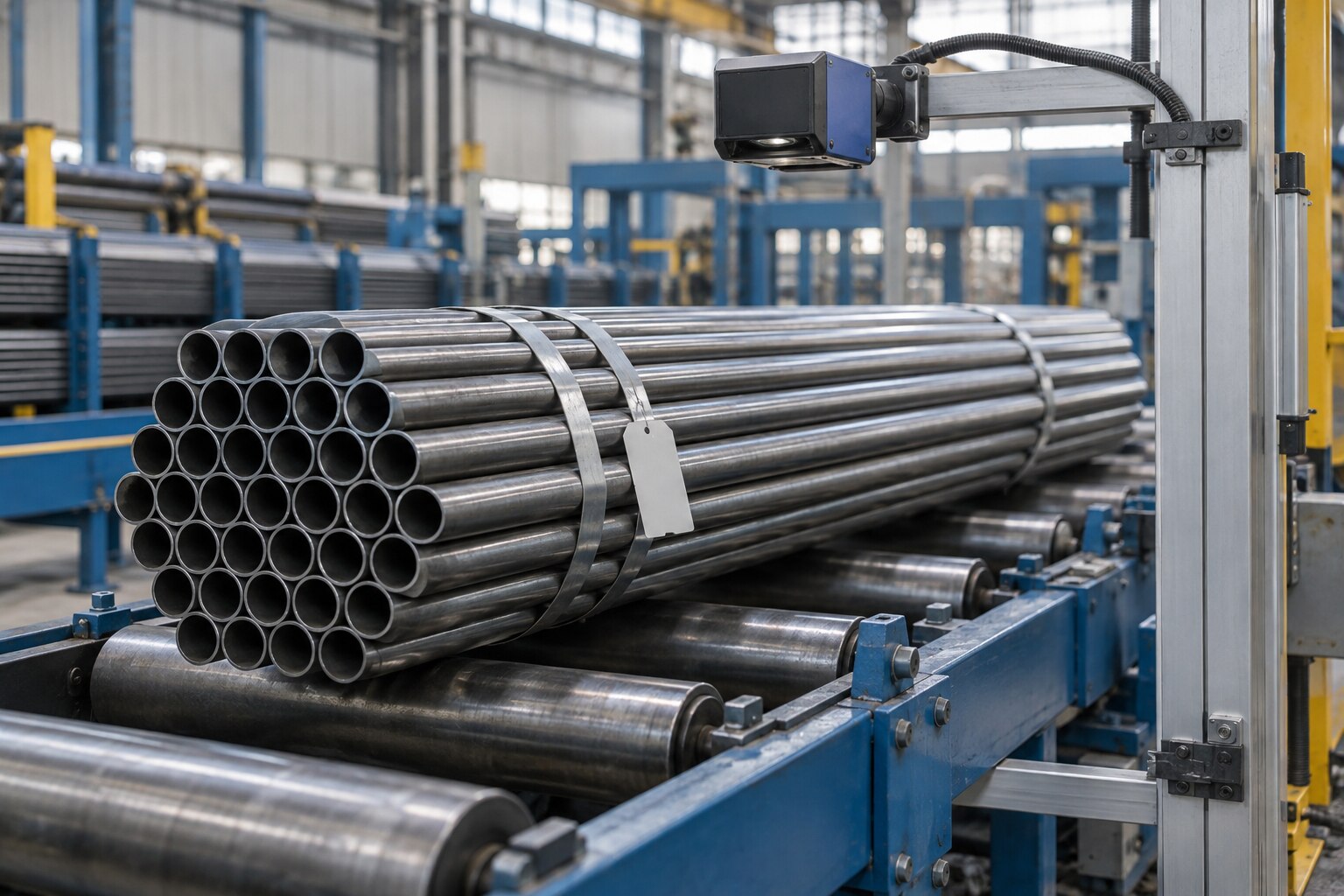
Treat placement as a mechanical issue in tube bundle tracking. Straps, forklifts and stacked bundles can hide one face, so mark two accessible sides, or pair a primary tag with a durable secondary mark tied to the same bundle record.
Print bundle ID, size, grade, heat or lot, quantity and customer order in human-readable text. Operators need that information when dirt, glare, damaged marks or a database outage defeats automated capture.
How the bundling system exchanges and protects traceability data
A bundle-close transaction is the control point: it reconciles physical tubes with production records before the bundle enters inventory. A pipe traceability system for tube bundling machine must identify the authoritative source for every field, rather than letting each device create competing records.
1. The mill PLC and MES provide the production order, heat, grade, coil, dimensions and cut list. The quality database supplies inspection status and disposition. The cut-to-length counter sends expected and actual quantity and length; the weighing system adds measured weight. The tube bundling machine owns bundle position, count confirmation, close time and label status.
2. Define the interface for ID reservation, accepted and rejected quantities, message acknowledgement, timeout, duplicate-ID response and release status. The ERP receives the completed transaction, while the warehouse-management system receives only a bundle cleared for storage or shipment. A label printer must print only after the ID and quantities are accepted.
3. Protect operation during host downtime with a controlled local queue or a pre-issued identifier range. Store the original event time, machine ID, operator action and reserved bundle ID locally, then reconcile each transaction when communication returns. Reject a duplicate ID; never reuse an old record or release an unreconciled bundle.
4. Record exceptions as new transactions, not edits to history: rejection after bundling, inspection opening, tube replacement, order reassignment, partial shipment and re-bundling. Link every successor or split bundle to its original parent and preserve the original close event.
This parent-child genealogy lets ERP, MES, quality and warehouse records agree while preventing duplicate labels and invisible material changes.
Which pipe traceability system benefits justify the project
The project earns its cost when it narrows a quality hold and speeds physical action. Complete genealogy lets you identify every affected bundle and shipment by heat, coil, production window or inspection result instead of stopping all production from a broad date range.
A controlled bundle-close transaction confirms expected and actual quantity, lengths, material identity and order before generating the bundle ID and releasing stock. Printing a label without that reconciliation creates identification, not reliable tube bundle tracking. Record removals, replacements, partial shipments and re-bundling as exception transactions; never overwrite the original event.
Measure the pipe traceability system benefits with:
- Label-read success rate
- Bundles with complete parent-child genealogy
- Minutes required to locate all affected bundles in a mock recall
- Manual-override frequency
- Duplicate-ID incidents
- Bundles held because records cannot be reconciled
For a pipe traceability system for tube bundling machine, compare proposals against these boundaries:
| Decision area | Evidence to require | Failure exposed |
|---|---|---|
| PLC and counter interface | Signals, acknowledgements and count ownership | Unreconciled quantities |
| Bundle close | Validation sequence and release rule | Labels for incomplete bundles |
| Offline recovery | Local queue, reserved IDs and timestamp reconciliation | Duplicate or lost records |
| Exceptions | Transactions for rejects, replacements, splits and re-bundling | Edited history |
| Integration | ERP, MES, quality and warehouse ownership | Conflicting master data |
Ask Gallium Equipment Pvt. Ltd. to document these sequences when reviewing custom machinery, not merely quote a printer or counter. Select the design against customer rules, workflow and storage conditions.
Related product
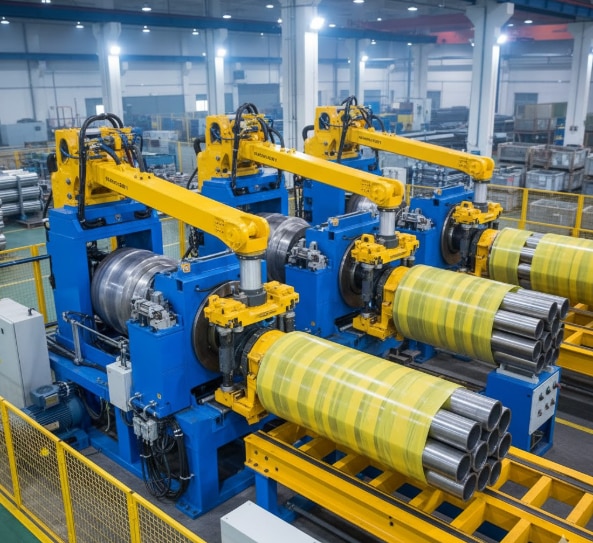 | Tube Bundling Machine The Tube Bundling Machine from Gallium Equipment Pvt. Ltd. is designed to automate the bundling and packaging of steel tubes with precision and... View product → |
Frequently asked questions
What must a pipe traceability system connect?
It must connect each pipe identifier with production data, inspection results, bundle records, handling events and shipment details.
How does identification prevent mixed bundles on the line?
Scan or verify pipe identifiers at loading, bundling and release points, then block bundles containing incompatible or unverified pipes.
Which marking method survives bundling, storage and shipment?
Choose a mark that remains readable after contact, moisture and handling; test ink, label or stamping on the actual pipe surface and bundle packaging.
How should a bundling system exchange traceability data?
Use controlled data exchange between the tube bundling machine, production system and shipping records, with access controls, audit trails and backups.
Which pipe traceability system benefits justify the project?
The strongest benefits are fewer mixed bundles, faster investigations, simpler recalls, accurate shipment records and less rework during sorting.
Keywords