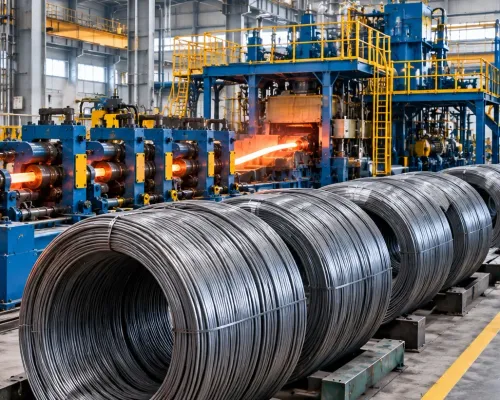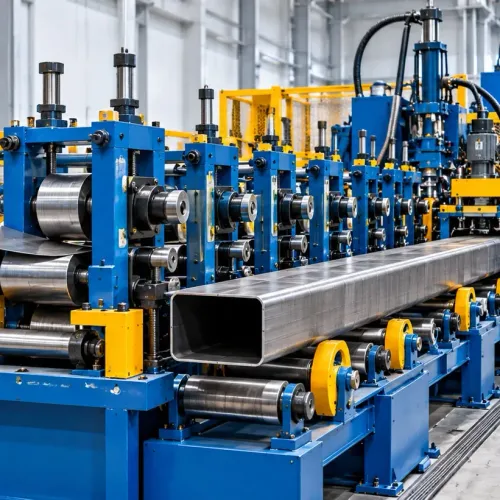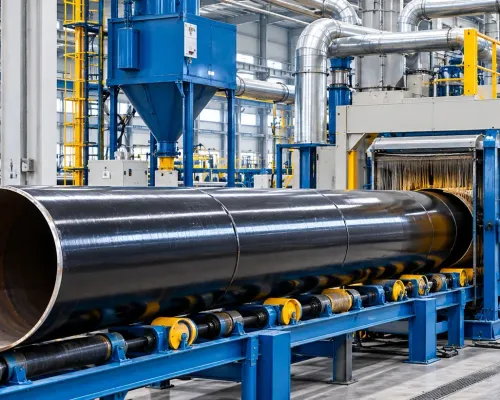
A galvanized coil is only as consistent as the complete process behind its zinc coating: strip preparation, annealing, bath chemistry, air wiping, cooling and finishing must work as one controlled sequence. By the end, you will know how the line keeps strip moving during coil changes, how to compare galvanizing with other corrosion-protection methods, and which technical requirements to put into a purchase specification.
Key takeaways
- Use a coil joining machine to maintain uninterrupted strip flow.
- Set coating mass with steel grade, end use and air-knife control in mind.
- Choose hot-dip, electro-galvanizing, paint or galvannealing for the required performance.
- Check line speed, furnace design, maintenance access and trial data before purchase.
How a continuous galvanizing line keeps strip moving
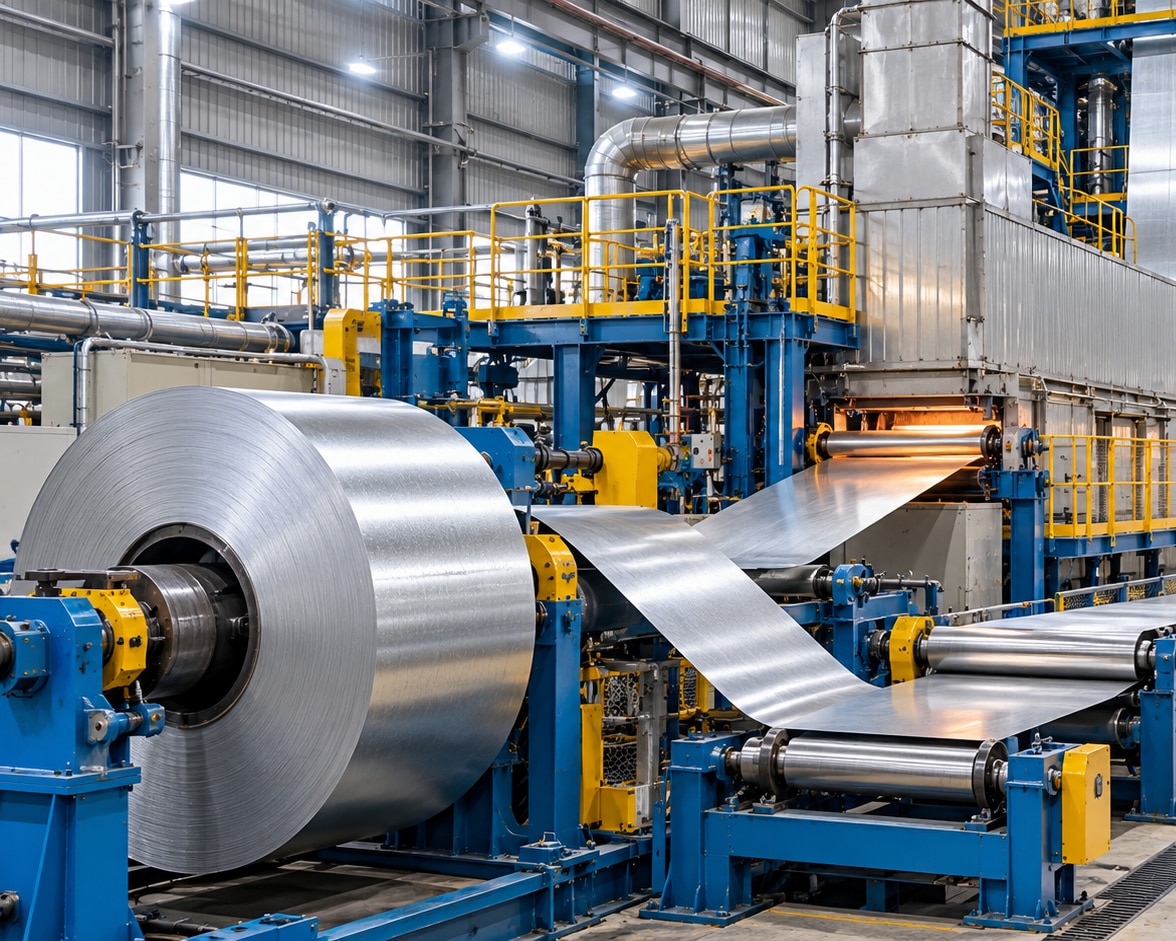
A continuous galvanizing line turns separate entry coils into one uninterrupted strip stream. The entry section pays off the coil, guides the strip and brings its tail to a coil joining machine.
The weld connects it to the head of the next coil, while an entry accumulator stores enough strip to keep the process section running during that change.
- The strip passes through cleaning and, where specified, pickling to remove oil, scale and oxides.
- The annealing furnace restores the required steel properties in a controlled atmosphere and prepares the surface for wetting.
- The strip enters a molten-zinc pot, where bath chemistry and temperature control the steel–zinc interface.
- Air knives wipe excess zinc from both sides and set the coating mass as the strip leaves the bath.
- Cooling solidifies the coating before the strip reaches the skin-pass mill or temper mill, tension leveler and chemical-treatment section.
- Inspection equipment checks surface defects and coating consistency; the exit section then recoils the finished strip.
During a coil change, the accumulator releases stored strip while the entry welder joins the next coil. The weld then travels through cleaning, annealing, the zinc pot and finishing equipment like any other section of strip. Operators identify or cut out the weld later if the customer’s coil specification does not permit it.
Tension control prevents buckling, while synchronized drives keep the strip centred and moving at line speed.
How cleaning, the zinc bath and air knives control coating quality
Uniform coating starts before the strip reaches the zinc pot. Cleaning and pickling must remove rolling oil, iron fines and oxides; residue prevents zinc from wetting the steel and creates bare spots.
In the annealing furnace, a nitrogen-hydrogen reducing atmosphere and controlled dew point reduce surface oxides while establishing the strip temperature and surface condition needed for adhesion.
The zinc pot normally runs about 450–465 °C, although zinc melts at 419.5 °C. Control bath aluminium and iron, sink-roll condition, strip entry temperature and dross removal; excessive temperature accelerates dross and equipment wear. Top dross can stick to the strip, while bottom dross can damage or disturb sink rolls.
For galvanizing line coating control, air knives set coating mass more than immersion time does. Gas pressure, nozzle geometry, knife-to-strip distance, strip speed, strip temperature and zinc viscosity must work together. Higher speed tends to leave a heavier coating unless wiping conditions are adjusted.
| Defect | What you see | Main checks |
|---|---|---|
| Bare spot | Exposed steel or an uncoated streak | Cleaning, pickling, furnace dew point and strip wetting |
| Heavy or light band | Coating mass changes across the width | Knife gap, pressure, nozzle alignment and speed |
| Pimples or raised particles | Repeated bumps or rough specks | Bath iron, aluminium, dross, rolls and skimming |
| Poor adhesion | Zinc lifts, flakes or peels during forming | Surface activation, bath chemistry and over-alloying |
Inspect both surfaces across the coil, not just the leading end. A defect that repeats at a fixed width position points to a knife or roll; random raised particles point to dross.
Hot-dip galvanizing versus electro-galvanizing, paint and galvannealing
Hot-dip galvanizing provides the best overall balance when steel needs durable corrosion protection, moderate forming, reliable welding and a finish that can remain unpainted. The zinc coating is thicker and more sacrificial than electro-galvanizing, while a continuous line controls coating mass across the strip.
| Finish | Main advantage | Trade-off and best use |
|---|---|---|
| Hot-dip galvanizing | Strong corrosion resistance and sacrificial protection | Use for exposed building, infrastructure and appliance parts requiring long service |
| Electro-galvanizing | Very smooth, precise, thin coating | Use for appearance-critical interiors or light corrosion duty; protection falls as zinc mass falls |
| Paint | Broad colour choice and high visual uniformity | Use when colour, insulation or a decorative finish matters; scratches expose steel and repainting adds labour |
| Pre-galvanized coil | Efficient coating before fabrication | Cut edges, punched holes and weld zones need extra protection after forming |
| Galvannealed steel | Paint-friendly surface, good weldability and controlled forming response | Iron-rich coating is duller and can powder or flake after severe forming |
Hot-dip galvanizing uses thermal energy for annealing and the molten zinc bath, so it is not automatically the lowest-energy finish. It becomes the stronger life-cycle choice when one durable pass avoids repeated painting, site repairs and premature replacement.
Choose electro-galvanizing for a thinner, smoother coating; choose galvannealed steel when painting and spot welding outweigh maximum bare corrosion resistance. A zero-spangle surface improves visual consistency but does not change the basic corrosion mechanism.
How to specify coating mass, steel grade and line capacity
A line cannot be sized from “galvanized steel” alone. Define the finished product, because a 0.40 mm deep-drawing grade at 1,600 mm width demands different entry equipment, annealing control and tension handling from a 2.00 mm structural strip.
Specify these requirements before requesting a line proposal:
- Steel grade, yield-strength range, tensile-strength range, elongation and formability class
- Strip thickness and width, including minimum, maximum and allowable width tolerance
- Entry and exit coil outside diameter, inside diameter, maximum coil mass and weld type
- Zinc coating designation, total coating mass, permissible side-to-side variation, spangle or zero-spangle finish, surface quality and chemical treatment
- Line speed at each product range, tonnes per year, operating hours, product-mix split and required yield
- Applicable standard, inspection method, sampling plan and coil documentation
| Standard | What to define or verify | Important comparison point |
|---|---|---|
| ASTM A653/A653M | Coating designation such as G90 | G90 is nominally 0.90 oz/ft², about 275 g/m², total for both sides; compare test results with the standard’s triple-spot and single-spot rules |
| EN 10346 | Steel grade and coating designation such as Z100 or Z275 | Confirm whether the order requires a total coating mass or a specified coating condition on each surface |
| JIS G3302 | Grade, coating class, surface finish and tolerances | Do not substitute an ASTM designation without checking the test basis and acceptance limits |
| ISO 3575 | Commercial, drawing or structural grade and zinc coating class | Confirm the exact edition and buyer’s inspection requirements |
State the minimum stable speed, not only the headline speed. A line rated for 180 m/min may fail the annual target if frequent coil changes, narrow strips or heavy coatings force prolonged operation below that figure.
How to evaluate a proposed galvanizing line before purchase
Approve a proposed galvanizing line only after the supplier proves performance on your steel grades, dimensions and coating designations. A presentation showing maximum speed is not evidence of saleable coil quality or the stated annual throughput.
1. Request a witnessed trial using your narrowest and widest strip, thinnest and thickest gauges, and highest-strength grade. Record entry speed, bath temperature, zinc chemistry, air-knife pressure and distance, strip tension, surface defects, coating adhesion and flatness.
2. Demand laboratory results for each trial coil. The report must identify both sides, sampling locations and ASTM A653/A653M results, including the average triple-spot value and lowest single-spot value. For G90, check the nominal 275 g/m² total mass rather than comparing the designation with one local reading.
3. Require a complete capacity model showing line speed, coil weight, weld and coil-change losses, planned maintenance, rejects and operating hours. Test the claimed annual throughput against your actual coil mix, not an empty-line maximum.
4. Inspect the proposed galvanizing line equipment list and control philosophy. Confirm the coating mass gauge, air knives, cooling section, skin-pass mill, tension leveler, chemical-treatment unit and inspection system, then ask for calibration certificates, alarm histories and sample inspection records linked to coil numbers.
Gallium Equipment Pvt. Ltd. can be assessed on the same evidence: require acceptance criteria for coating mass, tensile or yield properties, flatness, surface appearance and traceability before signing, with retesting rules if the line misses them.
Related products
 | COIL JOINING EQUIPMENT Coil joining equipment is placed prior to entry in accumulator & aids in shearing leading & lagging coil ends & but welds for smooth transition of... View product → |
 | COIL ACCUMULATOR SYSTEMS Gallium Horizontal Accumulators are available in several models based on Strip width range, Coil thickness and Operating line speed options. View product → |
Frequently asked questions
How does a continuous galvanizing line keep steel strip moving?
Payoff reels unwind entry coils, a coil joining machine connects strip ends, and bridles, looper equipment and tension controls maintain continuous movement through the line.
How do cleaning, the zinc bath and air knives affect coating quality?
Cleaning removes oil, scale and oxides before dipping; the zinc bath forms the coating; air knives remove excess zinc and control coating thickness across the strip width.
How does hot-dip galvanizing compare with electro-galvanizing, paint and galvannealing?
Hot-dip galvanizing provides a zinc coating through immersion, electro-galvanizing deposits zinc electrically, paint forms an organic barrier, and galvannealing alloys the zinc coating with iron for different forming and welding performance.
What should you specify when buying a continuous galvanizing line?
Specify coating mass, strip width and thickness, steel grades, target line speed, annual capacity, furnace conditions, zinc-bath controls, air-knife capability and inspection requirements.
Related products
 | DECOILERS DECOILERS Decoiler feeds slit coils to tube mills /Down stream equipment at a constant rate without damaging the strip surface & edges at constant speed. |
 | Autonomy and simplicity are critical at the starting gate to the mill. Gallium Equipment Pvt. Ltd. View product → |
 | COIL CARS Hydraulic operated coil cars with Motorized actuation for forward & reverse movement & hydraulic up down precision movement. View product → |