Choosing a tester by nominal pipe diameter or pump pressure alone can leave you with inadequate end restraint, slow cycles, unreliable leak decisions or an unsafe threaded connection. By the end, you will be able to convert the governing product standard, pipe envelope and production target into a machine specification that covers pressure, sealing, throughput, instrumentation and post-test handling.
Key takeaways
- Define pressure, hold time, leakage and deformation acceptance limits first.
- Treat threaded ends as both a sealing and axial-thrust problem.
- Size pumps and instruments for the complete fill, pressurise and hold cycle.
- Choose single-pipe, multi-pipe or online testing from production flow needs.
Identify the acceptance test before you specify the machine
Before you choose a hydrostatic testing machine, identify exactly what the acceptance test must prove: water-filled pipe, trapped air removed, specified pressure reached, pressure held for the specified period, and no unacceptable leakage, pressure loss or permanent deformation.
The governing document—not yield strength, nominal burst pressure or a supplier’s standard five- or ten-second cycle—sets the pressure, stabilization rule, hold time and leak criterion.
| Document | What it may control | Selection consequence |
|---|---|---|
| ASTM A500/A500M | Dimensions, mechanical properties and workmanship | Do not assume it requires universal hydrostatic testing |
| ASTM A53/A53M | Pipe requirements, including hydrostatic provisions for applicable products | Obtain the exact grade and test clause |
| API 5L | Product acceptance and pressure-test requirements for line pipe | Confirm pressure, hold and recording requirements |
| EN 10219 or EN 10255 | Product-specific requirements for structural hollow sections or steel tubes | Verify the applicable test provision and size range |
| Purchase order or project specification | Customer pressure, hold, leakage and documentation rules | Treat stricter project terms as controlling |
Ask for the exact standard edition, grade, outside diameter, wall thickness, length, thread and whether testing covers bare pipe, a coupled pipe or a finished assembly. A threaded structural pipe order that names ASTM A500 alone may define no hydrostatic acceptance test; obtain written confirmation before pricing equipment.
Record the required test pressure, pressure-hold duration, stabilization method, allowable pressure loss, visible-leak rule and retest procedure. Specify those values for the smallest and largest pipes, because a machine suitable for one order is not automatically suitable for the next.
Treat threaded ends as a sealing and thrust problem
A threaded end turns the test into a sealing and thrust problem, not merely a pressure problem. Specify the exact thread form, pitch, engagement length and end condition; a generic threaded plug can damage the product or seal on a crest while leaving a defective root undetected.
The test station must match the article sold. State whether the pipe is tested bare, with its production coupling, or as a finished assembly, and choose threaded plugs, expanding mandrels, external clamps or a test coupling accordingly. A seal positioned beyond the inspection area can hide thread damage or coupling leakage.
Pressure thrust sets the frame size. Calculate it as F = P × πD²/4 using sealed internal diameter D. At 10 MPa with a 300 mm internal diameter, the theoretical load is about 707 kN before safety factors, friction and pressure transients.
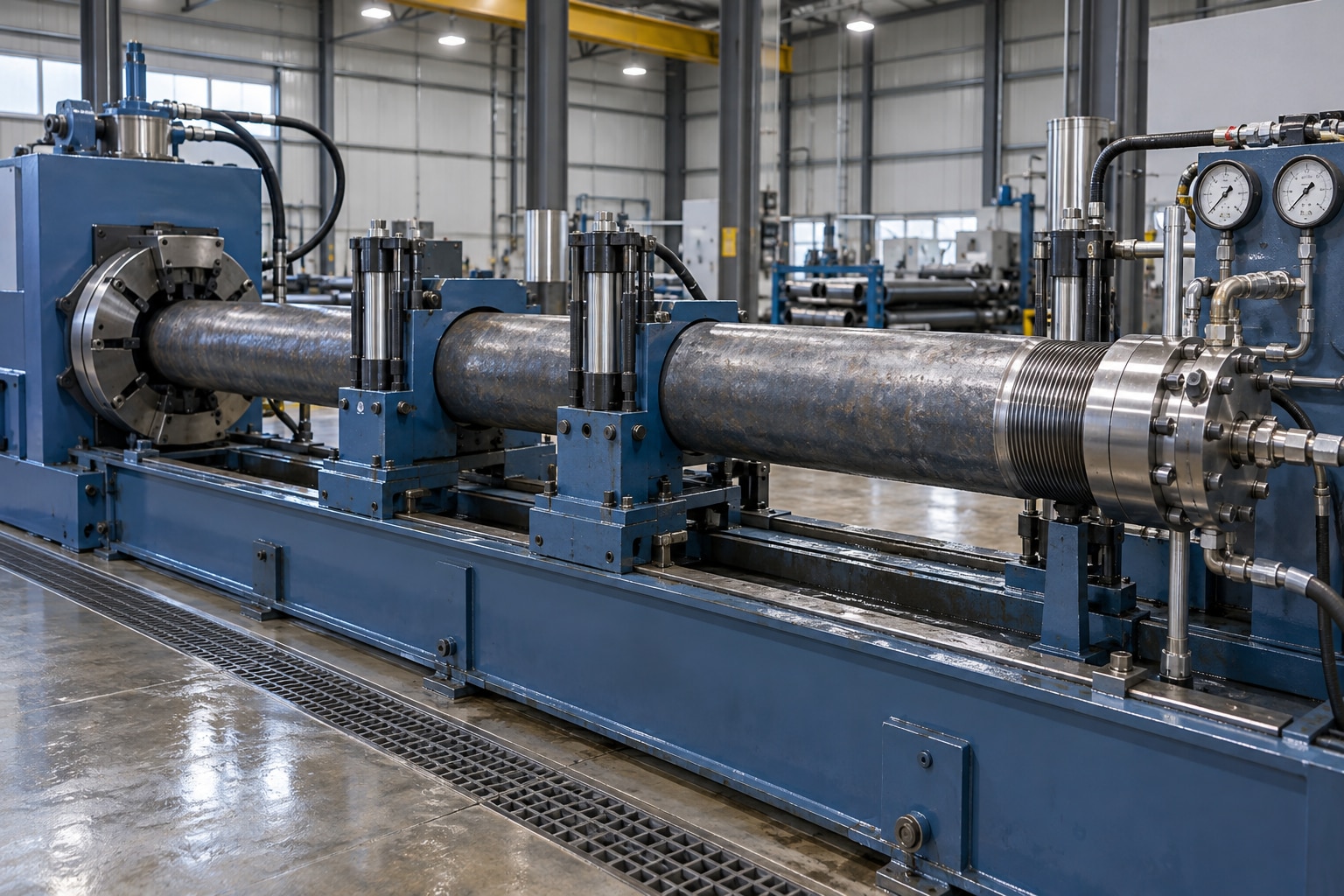
The hydrostatic pipe testing machine needs rated end heads, plug engagement and positive restraint for that load.
Remove trapped air before pressurising: compressed air stores energy, causes unstable readings and can turn a failed seal into a sudden release. Specify controlled filling and venting, guarded access, relief-valve discharge routing, controlled depressurisation and a zero-pressure interlock.
Check these dimensions before selecting the station:
- Outside diameter, wall thickness, cut length and end squareness
- Ovality, thread form, coupling outside diameter and seal space
- Interchangeable seal sets for inconsistent ends
- Proof of restraint rating for every plug and test-head configuration
A thread tester cannot replace weld examination; ERW weld quality may still require ultrasonic, electromagnetic or eddy-current inspection.
Size pressure, flow and measurement for the real test cycle
Usable test pressure comes from the governing product standard and purchase order, not from the pump’s maximum rating. Specify the target pressure, allowable tolerance, stabilization time and hold time, then select a pump and frame rated above that pressure and the end thrust: F = P × πD²/4.
At 10 MPa, a 300 mm internal diameter creates about 707 kN before safety factors and pressure transients.
Calculate filling capacity from the actual water volume:
- Test-piece volume: V = πDᵢ²L/4, using internal diameter Dᵢ and tested length L.
- Total fill volume: test-piece volume plus end-head, hose, valve and manifold volume.
- Required fill flow: total volume divided by the permitted filling time.
- Cycle time: filling, air evacuation, pressure rise, stabilization, hold, depressurization and draining.
The filling pump must meet the required flow through the specified filling-line diameter. A high-pressure pump with a small delivery rate can maintain pressure yet miss production speed. Include the shortest and longest pipe, because volume and air-removal time change with length.
Prevent false rejects by separating product leakage from fixture leakage. Log pressure and flow against pipe or bundle identification, monitor each test head independently, and stabilize water temperature and trapped air before the hold begins. A pressure drop alone proves nothing: expansion, temperature change, seal settling and air can produce it.
Define acceptance as visible product leakage, pressure loss, or both, and require resealing followed by a repeat test when a head seal leaks. That is essential to sound pipe testing machine selection.
Choose single, multi-pipe or online testing around production flow
An offline individual-pipe tester is the right choice for variable sizes, short runs, frequent changeovers or modest production volume. It lets operators load a threaded pipe, seal its ends, complete filling, air removal, pressure hold, draining and inspection without redesigning the whole line.
| Option | Flow fit | Main advantage | Added complexity | Choose it when |
|---|---|---|---|---|
| Single offline position | Intermittent or mixed production | Lowest installation and changeover burden | Manual loading and one pipe per cycle | Sizes, lengths or thread configurations change frequently |
| Multi-position offline system | Repetitive production with several stages | Fills, holds and drains different pipes in parallel | More fixtures, controls, guarding and water circuits | The test cycle is the bottleneck and demand keeps operators occupied |
| Integrated online system | High-volume, stable production | Automatic transfer, identification, testing and reject segregation | Line integration, synchronization and maintenance downtime | Output justifies continuous material handling and a narrow product range |
A multi-position industrial hydrostatic tester earns its cost when parallel stations hide filling, stabilization, hold and draining time; a faster pump alone will not create that capacity. Specify the internal volume, target cycle, air-evacuation time and changeover method before comparing station counts.
Choose an integrated line only when upstream threading and downstream handling can maintain the same takt. Otherwise, one jammed end-seal, contaminated plug or rejected fixture can stop production across the line. Require pressure and flow records, pipe identification, automatic reject marking and a repeat-test rule that separates fixture leakage from a defective pipe.
Turn the pipe range and quality rules into a purchase specification
State the exact acceptance document before asking for a price. Name the standard and edition, grade, purchase-order requirements, test pressure, hold time, allowable pressure loss, pipe range and whether hydrotesting applies at all; ASTM A500/A500M is not, by itself, a universal hydrostatic acceptance requirement.
Specify that weld examination remains a separate electromagnetic, ultrasonic or eddy-current requirement where applicable.
Use the following hydrostatic testing machine for selection checklist:
- Outside diameter, internal diameter, wall-thickness range and maximum pipe length
- Thread form, nominal size, engagement length, bare pipe or coupled assembly, and plug or coupling design
- Required pressure at every size, hold time, filling rate and target cycle time
- End-load calculation using F = P × πD²/4, plus frame, head, plug, restraint, seal and transient-load ratings
- Guards, door interlocks, pressure relief, emergency depressurisation and safe access
- Pressure and flow logging, pipe or bundle identification, leak-source diagnosis, reject marking and reseal-and-retest rules
- Filtered or treated water quality, drainage, blow-off or drying, corrosion control and maximum time from test to preservation
Require general-arrangement drawings, utility loads, foundation details, calibration certificates, control-system backups, seal and plug life, spare-parts lists, commissioning tests and operator training. Ask Gallium Equipment Pvt. Ltd. to show how its proposed machine handles the largest diameter and pressure-thrust case, not merely the pump’s maximum rating.
The supplier must also identify exclusions, such as threading, weld NDT, drying or preservation equipment.
Frequently asked questions
What should you define before selecting a hydrostatic testing machine?
Define the test pressure, hold time, allowable leakage or pressure loss, deformation limits, water temperature and the pipe acceptance standard.
Why do threaded pipe ends complicate hydrostatic testing?
Threaded ends require seals that withstand the test pressure while resisting axial thrust from the closed, pressurised pipe.
How do you size a hydrostatic pipe testing machine for the real cycle?
Use pipe volume, fill time, pressure-rise time, hold time, drain time and test frequency to size the pump, reservoir, valves and instruments.
When should you choose single-pipe, multi-pipe or online testing?
Choose single-pipe testing for flexibility, multi-pipe testing for batch throughput and online testing when production flow supports integrated inspection.
Keywords