A pipe can pass inspection and still be difficult to trace when its bundle label is separated from the material, a coil is split, or a weld excursion affects only part of a run. By the end, you will know which data to capture, where to capture it, how to connect mill records to shipments, and how to test whether your system can support a real recall.
Key takeaways
- Link every pipe to its heat, coil, order, weld run and inspection record.
- Use durable IDs on pipes, bundles and shipments, with barcode scans at handoffs.
- Record rework, scrap and relabeling as controlled events in the original genealogy.
- Connect PLCs, inspection systems, operator entries and ERP shipment records.
What a Pipe Traceability System Must Prove
A pipe traceability system must prove complete pipe genealogy, not merely assign a serial number to finished material. Each pipe or bundle must link to its steel heat, mill test certificate, mother coil, slit-coil or strip identity, production order, forming and welding run, cut position, inspection results, operator actions and final shipment.
1. Start the chain at receipt. Record the heat number, mill test certificate and coil number, then preserve those links through coil number tracking, production dispatch, slit-coil use and every finished length.
2. Store a minimum record for each pipe or bundle: steel grade, outside diameter, wall thickness, length, production date and time, line number, bundle number and inspection status. Add the production order and the pipe number or cut-length number so operators can identify the physical item.
3. For ERW or HFI production, associate process data with the actual longitudinal position, not only the whole coil. Capture weld power or current, frequency, line speed, squeeze-roll settings, impeder condition, weld-temperature indicators, scarfing settings, recipe revision, machine identity and calibration status.
4. Treat inspection as evidence, not a pass or fail flag. Retain the test method, instrument identity, calibration state, procedure revision, timestamp, result and approving operator.
A pipe number, cut-length number or distance from coil start matters because a short weld excursion or defect can affect only part of a run; those references let you isolate the affected lengths and complete a forward-and-backward recall.
Where Data Is Captured and How Records Stay Connected
Capture identity at handoffs, not by retyping it throughout the pipe production workflow. At receipt, scan the mother-coil number, heat number and mill test certificate, verify grade and dimensions, then create the ERP material record and production order link.
1. At coil loading, scan the coil and confirm the scheduled order. Record coil joining, slit-coil changeover, run start and run end; inherit the heat and coil IDs into the MES production run. Forming, welding and sizing receive machine events and process values through PLC integration rather than manual entry.
2. At cutting, assign each cut length a sequence or position reference linked to the run. Attach straightening, test and inspection results to that identifier, including disposition, method, instrument and timestamp. MES traceability then carries the same genealogy into the bundle number, label, warehouse movement and shipping document.
3. Enforce scans at material receipt, coil loading, changeover, run start and end, cutting, inspection disposition, bundling, warehouse movement and shipment. These controls catch a wrong coil or misplaced bundle where the physical identity changes; scanning every machine action adds effort without equal control.
Use ISA-95 to keep responsibilities clear: ERP owns orders and material masters; MES owns production dispatch and genealogy; PLC or SCADA systems provide machine events and process values. During a network outage, the line must buffer events locally with timestamps and sequence numbers, continue recording production, and reconcile them later without duplicates or reordered records.
A failed connection must never create an unrecorded production gap.
How to Identify Pipes, Bundles and Shipments on the Floor
Use two identifiers: a durable physical mark and a database link to an internal pipe or bundle ID. Inkjet can vanish during forming, cutting, coating or handling, while a single label can be torn off or damaged by weather.
| Option | Durability | Read speed and cost | Line of sight | Main vulnerability |
|---|---|---|---|---|
| Stamped or stencilled mark | High | Slow, low cost | Required | Coating, end-facing and wear |
| Barcode label | Medium | Fast, low cost | Required | Water, abrasion, handling |
| QR code | Medium | Fast, low cost | Required | Smudging, damaged surfaces |
| RFID tag | High with protection | Very fast, higher cost | Not required | Metal interference and tag damage |
| Operator-entered record | None physically | Slow, low hardware cost | Not applicable | Transcription errors and false genealogy |
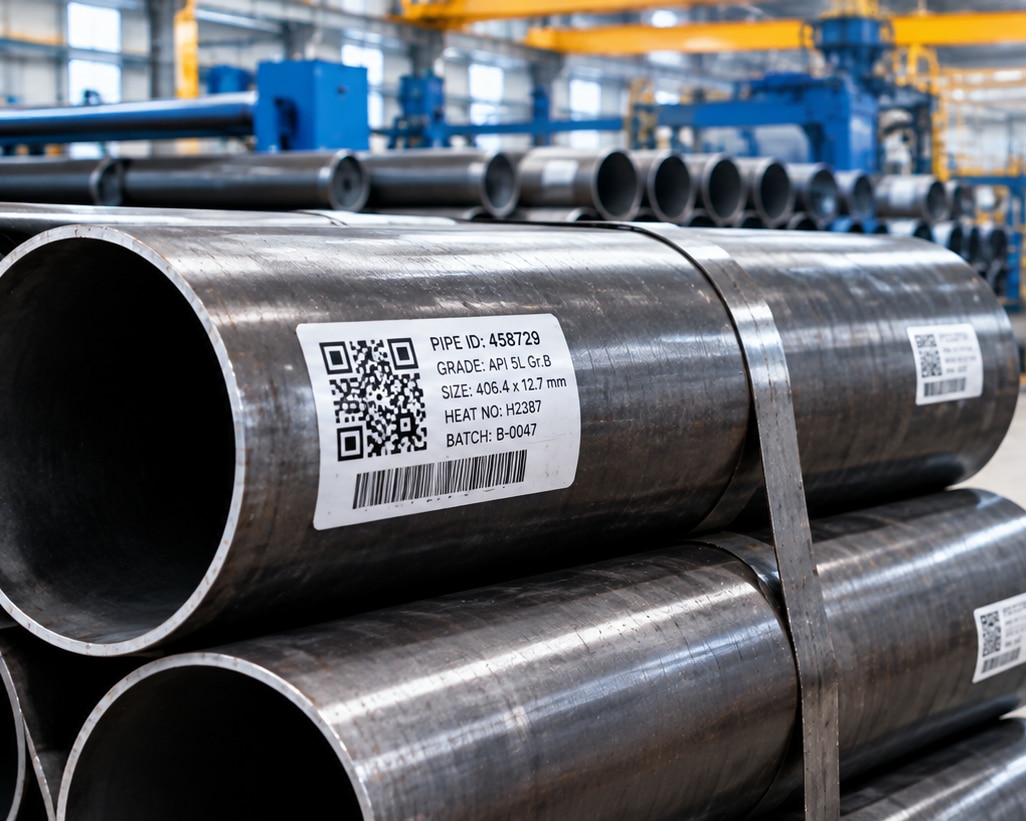
For barcode pipe tracking or QR code traceability, scan at cutting, inspection, bundling and dispatch. Use RFID pipe identification where bundles move rapidly or labels cannot face the reader.
A bundle label cannot replace piece-level genealogy. Record the exact member list, length, grade, heat and quantity when a bundle is created, split, mixed, re-bundled or shipped in parts.
- Quality inspectors need the heat, coil, grade, dimensions, inspection status and production date.
- Warehouse operators need the bundle number, quantity, weight, status, location and order number.
- Customers need the bundle number, heat, grade, dimensions, quantity, status and shipment reference.
Sample label: Bundle No.; Heat No.; Coil No.; Grade; OD; wall; length; quantity; inspection status; production date; line No.; order No.; barcode or QR code; net weight. Keep process values, operator actions and audit history in the database.
How to Control Exceptions Without Breaking Genealogy
A split coil or rejected pipe must create a new traceability event, not erase the old record. Treat every exception as a controlled transformation with a reason, quantity, status and accountable approver.
1. Define rules for split coils, mixed bundles, remade pipes, rejected pieces, downgraded material, bundle breaks, relabelling and partial shipments. Each event must retain the original heat and coil links, create a new identifier where needed, record the resulting quantity and status, name the approving user, and preserve the old identifier as historical data.
2. Maintain separate, clearly marked locations for accepted, quarantined, rework, scrap and downgraded material. Enforce quarantine control with scans that validate both the item and destination, plus visible status signs or lights. This prevents a correct database entry from being attached to the wrong physical pipe.
3. Make rejected pipe tracking include every failure, repair, remade length and scrap disposition. A test record must retain the method, instrument identity, calibration state, procedure revision, timestamp, measured result and disposition authority—not merely “pass” or “fail.”
4. Run a forward and backward recall before acceptance. Start with a shipment and retrieve its heat, coil, run, settings, tests and related lengths; then start with a suspect heat and retrieve every pipe, bundle, shipment, rework record and scrap disposition.
5. Set measurable acceptance limits for retrieval speed, record retention period, audit-history completeness and export format. Test partial shipments, dissolved bundles and relabelled material, then verify that every change shows who approved it and when.
What Equipment and Software You Need to Implement It
Buy the traceability equipment as one connected system, not as a printer added beside production.
Specify fixed or handheld scanners, an industrial label printer for barcode or QR labels, label applicators, industrial computers, line encoders, inspection instruments, weighing scale integration, and PLC or MES connections to a central traceability database with role-based access and audit history. Add RFID readers only where non-line-of-sight reading justifies their cost.
1. Reject a scan when the grade, order, heat, station or status does not match the active job. Block duplicate pipe, bundle and shipment identifiers. Flag unreadable labels for reprinting, and require an authenticated user, reason and timestamp for every manual override.
2. Place printers at the point where identity changes, not in a remote office. Protect labels from heat, oil, abrasion and handling; use controlled bundle lanes and separate quarantine bays. Lock the scale-to-record link so an operator cannot attach a correct weight to the wrong bundle.
3. Before purchase, map every handoff from coil receipt to dispatch; define data-retention and retrieval targets; test network-outage recovery; verify inspection-instrument calibration records; and run mixed-bundle, re-bundling and partial-shipment scenarios.
4. Commission the system with a two-way recall: shipment to heat, coil, run, settings and tests, then suspect heat to every pipe, bundle, shipment, rework and scrap record.
Gallium Equipment Pvt. Ltd. is a sensible equipment-integrator candidate when traceability signals must connect directly to tube-processing machinery instead of becoming a disconnected office database.
Frequently asked questions
What must a pipe traceability system prove?
It must connect each pipe or bundle to its steel heat, mill test certificate, mother coil, slit coil or strip, production order, forming and welding run, cut position, inspections, operator actions and shipment.
Where should pipe traceability data be captured?
Capture data at receiving, slitting, forming, welding, cutting, inspection, bundling and dispatch, then connect each event through a persistent pipe, bundle or shipment ID.
How should you identify pipes, bundles and shipments?
Use durable labels or marks with unique IDs and scan them at each handoff. Keep the pipe ID linked to its bundle ID, shipment ID and customer documentation.
How do you handle rework, scrap and other exceptions?
Create an exception record that preserves the original ID, reason, operator, time, disposition and replacement or rework relationship instead of deleting or overwriting genealogy.
What equipment and software support pipe traceability?
A workable system combines barcode or RFID identification, industrial scanners, marking equipment, PLC and machine interfaces, inspection-data capture, a production database and ERP or shipment integration.